Rounding Biwa, Japan’s Largest Lake

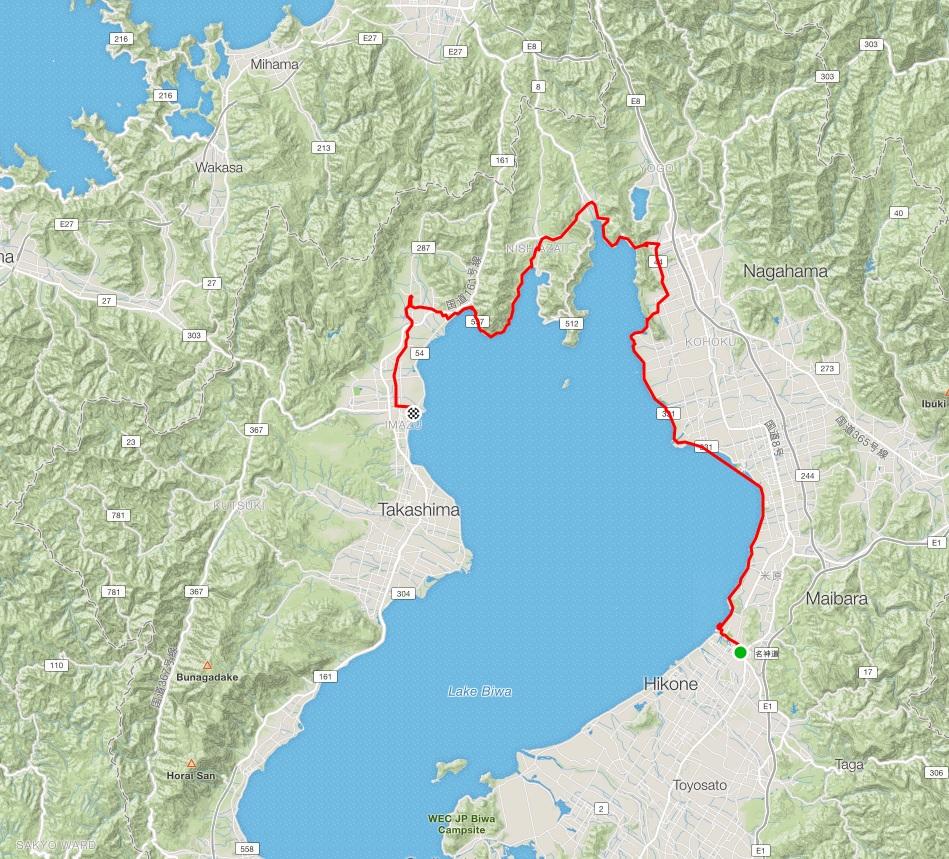
Blessed with a long weekend and loads of motivation, Kangaeroo and Mrs. Kangaeroo got out the foldups and built up the resolve to circumnavigate Biwa, Japan’s largest lake.
The 235-km shore length is not for the faint-hearted, though plenty make the trip in a single day, courtesy of the almost completely flat course.
Nonetheless, it’s a demanding distance for irregular cyclists, so Kangaeroo had cause for concern regarding the missus, who admittedly cycles day, but does so on an e-bike and not an old foldup with no track record of triple-figure journeys.

Anyway, putting aside the concerns, Mrs. Kangaeroo remained deeply confident of her abilities and plotted out the trip, designing it to have full enjoyment at the lowest possible cost.
Thus the Kangaeroo couple headed out from home late on Friday night, racing to Kawasaki to catch the bus to Hikone, from where their circumnavigation would start.

Arriving at the bus stop and folding and bagging the deadly treadlies, Kangaeroo was surprised when the jobsworth driver informed him that bus company policy was to not carry bikes.
“We’ll let you on this time, but take no responsibility for any damage that occurs in transit,” the officious driver said.

“Yeah, whatever.”
The driver then wrapped the bikes in blankets, ensured no luggage was around them and went to enormous pains to make sure the bikes would be safe.
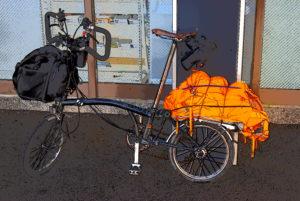
And, indeed, the Brompton and BD-1 were safe and unscathed when the bus finally made its way to Hikone the following morning, arriving more than 1 hour late thanks to roadworks and heavy traffic.

The less than ideal start was compounded by Kangaeroo having caught a cold, leaving him coughing and spluttering with snot running riot.
Countering that, though, was glorious weather. Blue, sunny skies and welcoming warmth greeted the riders as the foldups were unfolded, the luggage packed on the Brommie’s racks, and the riders set off.

Just one problem….which way to go? Fortunately, there was a sign to Hikone Port not far from the station and that seemed a logical place to head for considering the city is located on the lake (and not the sea).
Within a few minutes riding along the moat of the city’s renowned and beautiful castle moat, the Kanagaeroo crew reached the port and found the huge blue arrows that serve as the indicators for the Biwaichi, the abbreviation of 琵琶湖一周 (biwakoisshuu), or circumnavigation of Lake Biwa.
The remainder of the day was simply exquisite!
We rode north from Hikone, essentially hugging the lake’s shoreline.
It didn’t take long to reach Nagahama, the first big town after leaving Hikone, and also with a notable castle of its own, surrounding with a lovely garden.
Kangaeroo was worried about the missus, having seen seasoned riders struggle a little on a less than 80-kilometer trip in Kyushu just last month.
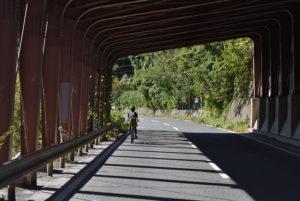
But she was resilient, pounding away on the Birdy’s pedals and less susceptible to the call for a cuppa than Kangaeroo.
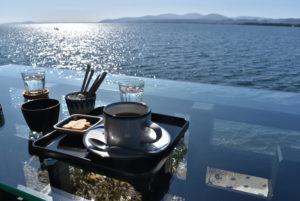
A snack was partaken at a delightfully quaint, lakeside cafe basking in the sun in Takashima.
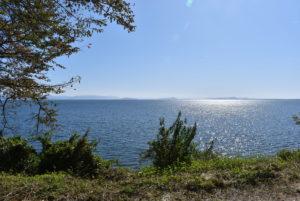
From there, it was a couple of kilometers off the beaten track to the Makino Metasequoia, a row of redwoods leading to Makino Pick Land, where punters can at times gather their own fruit for eating.
On the day the Kangaeroo crew arrived, there was a local market going on.
While Mrs. Kangaeroo went of to get a French lunch, Kangaeroo clumsily carried the bikes up a flight of stairs to score a seat.
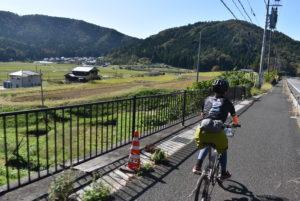
Well, it was a right mess, but people flocked from all sides to help out, including another Aussie, who was there with her hubby and we had a wonderful conversation.
True to form, her hospitality was outstanding and we tucked into our French fare armed with an invitation to drop by her home during our trip.
Having eaten more than out fill, it was off to Imazu, where we would end the first day’s journey.
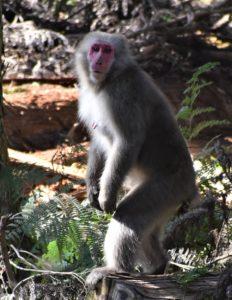
We even saw a couple of wild monkeys along the way!
The Imazu Sun Bridge hotel, while being nothing flashy, was simply outstanding in terms of its handling of cyclists and bicycles.
We were warmly welcomed, the bikes wheeled into a protected area behind the Reception Desk and the staff treated the bicycles with great care.
Imazu would be a nondescript town were in not for the existence of a few prewar buildings designed by an American architect who would naturalize and spend the war interred in Karuizawa.
After a tour of these buildings, it was back to the hotel room to watch the Rugby World Cup final where the Springboks blanketed England, ending an amazingly well-coordinated event where Japan excelled itself both on and off the field, as well as turned Kangaeroo into a rugby fan having (erroneously) previously dismissed it as a rich boy’s sport with little appeal.