Terrible Trainspotters

Trainspotters in Japan, referred to somewhat derogatorily as Tetsuo (鉄男) or Tetsuko (鉄子)(a play on words forming a portmanteau from the words for “rail” and common suffixes used to indicate a man or woman <there are commonly still only two genders in Japanese>, as well as being typical <though slightly archaic>names) have a well-earned reputation for being rude.

It’s a common perception that trainspotters crowd public thoroughfares and are pushy and ill-mannered as they await for the chance to get their photo of a train.

I’d say the vast majority are just keen snappers and it’s only the antisocial behavior of the odd one here or there that causes widespread ire.

But today I got to experience annoyance from trainspotters first hand. They were waiting for some special train running along the JR Chuo Line, which I pass under a couple of times at various points during my customary morning ride.

At one point near a bridge, I was astonished to see a couple of dozen or more trainspotter had set up their elaborate cameras to take a shot.

Notably, they had crowded the stairs I use to carry my bike from the bike path at the point where it shifts from the bottom to the top of the levy running alongside the Tama River.

There was no way i could get through. And I was astonished to find that there was no way they were going to give ground to allow me to pass.

What I should have done was just stand in front of their cameras and spoil the shot. What I did do, in a rare show of maturity, was smile and acknowledge the efforts they’d made to get a good spot for the photo and walked up the embankment.

Call it people pleasing, perhaps, but I was on a bit of a high because it had been a glorious morning with a simply breathtaking view of the full moon setting and a wonderfully clear Mount Fuji.

I rued not having brought my own camera with me and having to rely on the terrible shots I get from my mobile phone.

And I also remembered the old days of being in a media scrum and how tough it was to position yourself to get a shot and how much I had fought against other snappers in an effort to get the best pic.

Most of all, though, is that I’ve just lost the will to fight. Especially battles I have no hope of winning. I would like to think I wouldn’t behave in the same way as the trainspotters, but experience has showed me that put in a similar situation, I have usually done so.
Cop A Gander At These Rippers Too...

  • What To Do?

    When Kangaeroo started back in 2010, the aim was probably to help students understand that American was not the only form of English and that Australians speak Strine. What the aim intended to accomplish remains unknown. At some point, the blog became an area to examine lesser-known aspects of the Japan-Australia relationship. For the first five years of its existence, Kangaeroo.com was updated almost daily. It’s initial aim was not accomplished because I couldn’t get enough people to read it. Same goes for its subsequent purpose, I guess. That probably goes some way to explaining why updates have been sporadic at best over the past several years. But I am…

  • | |

    Australiana for Australia Day

    オーストラリア人コメディアンオーステン・テーシャス氏*が1983年豪州象徴的なものや地名などのごろ合わせによって詩「Australiana」で全国一世風靡し、No. 1ヒットとなった。かなりやばい言葉使いであり、色な所で放送禁止となった。 1月26日建国近年日にあたる「Australia Day」にちなんで、下記再現する。お楽しみ。 Australiana Sittin’ at home last Sunday mornin’ me mate Boomer rang (boomerang). Said he was havin’ a few people around for a barbie, Said he might cook a burra (kookaburra) or two. I said, “Sounds great, will Walla be (wallaby) there?” He said “Yeah and Veggie might (Vegemite) come too”. So I said to the wife “Do you wanna Go Anna (goanna)?”. She said “I’ll go if Din goes (dingoes).” So I said “What’ll (wattle) we do about Nulla?” He said “Nulla bores (Nullarbor) me to tears, leave him at home.” We got to the party about two and walked straight out the kitchen to put…

  • Chuck It, Throw It, Stage It, Hurl It, Or Lose Your Lunch Over It

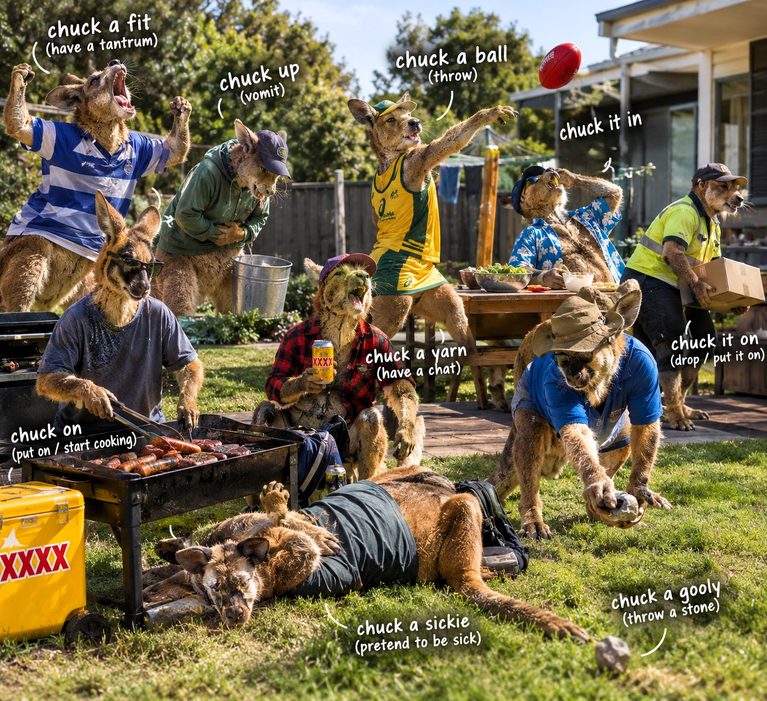
    「Chuck」は投げるだけじゃない “Chuck it over here!” ボールを投げてもらいたいときなら、「こっちに投げて」。ところがAussie英語の chuck は、それだけではありません。「吐く」という意味にもなります。 さらに chuck a fit や chuck a wobbly のように、「癇癪を起こす」「騒ぎを起こす」という使い方もあります。オーストラリア国家大学も、Australian Englishでは chuck が throw や stage の意味で使われることを説明しています。 Word chuck Meaning 投げる、放る。また、「吐く」という意味や、chuck a fit のように「癇癪を起こす」という意味でも使われます。 Example “That’s good, Amanda. Chuck the ball to Uncle Dove.” 「いいぞ、Amanda。ボールをDoveおじさんに投げて。」 “He had too much to drink and chucked.” 「彼は飲みすぎて吐いた。」 “If the ankle biter doesn’t get his own way, he chucks a fit.” 「そのチビが思い通りにならないと、すぐ癇癪を起こす。」 日本語で言うと? 文脈によって意味が大きく変わります。throwなら「投げる」。vomitなら「吐く」。chuck a fitなら「癇癪を起こす」。Aussie英語では、こうした文脈依存の動詞が日常会話でよく登場します。 Australia-Japan Connection 日本語にも「やる」「かける」「取る」のように、文脈によって意味が変わる動詞があります。chuckも似たところがあります。単語だけを覚えるより、実際のフレーズで覚えるほうが理解しやすいでしょう。 chuck を見て、毎回「投げる」と訳してしまうと、Aussie英語では困ることがあります。特に chuck a fit は、文字どおりに訳すと意味が分からなくなります。 Related Links

  • ‘Pterror’ Trauma Transforms Into A Tantalizing Turn

    Dino, our modern pterodactyl–or “pterror-dactyl” as I prefer to call her for her innate ability to traumatize–has been crook for a while without showing signs of a complete recovery. I would give anything for her to resume her reign of pterror. The rosy faced lovebird who rules our roost has an infection after eating too much human food. Poor Mrs. Kangaeroo has for months been finishing grueling nightshifts and taking the bird on a draining journey to the avian vet. Mrs. Kangaeroo has also overseen the bird’s strict diet and medicine administration. Dino is better than her worst state, but is not her aggressive, dominating self. Dino continues to struggle…