Aussie ‘X’ Gender Passports Given the Wako Treatment in Japan

Wako University’s train posters.
Australia’s revolutionary passports have been given the Wako treatment in Japan.
No, that’s not a spelling mistake (it’s pronounced Wah-Koh, not whacko), nor does it mean Down Under travel documents are being held up to ridicule.
In fact, Wako University, a tertiary institution located in the outer Tokyo suburb of Machida, typically uses posters hung up in the carriages of capital area trains to provide a short lesson for commuters.
The university’s current poster focuses on how Australia now deals with the issue of gender when it comes to issuing passports.
The distinctive yellow posters, effectively an advertisement for the privately funded university, feature a kangaroo with joey and people traveling through what is probably supposed to be Immigration Control at an airport.
The posters hail the Australian practice of allowing passport holders to state their gender as either “male,” “female” or “X” is being held up as a virtuous practice that signifies changing recognition of societal norms.
Wako is probably best known in Japan for rescinding an entry offer it made to one of the daughters of Shoko Asahara in 2004. Asahara, of course, was the Aum Shinrikyo cult guru convicted for masterminding the 1995 Tokyo Subway Sarin Gas Attacks that killed 12 and left thousands more sickened. While the university may preach tolerance and show support for it in things like the posters, it doesn’t always necessarily act that way. Incidentally, the president of the university at the time had just published a book expressing outrage at discrimination.

A Translation of the Train Carriage Poster Message:
Gender is decided from the moment we’re born. But that accepted thought may be about to change. A good example of that comes from Australian passports. As well as ‘man’ and ‘woman,’ they also have a selection option of ‘X’ to describe gender. This change was brought about in response to claims made by sexual minorities and to limit discomfort at Immigration Control when the stated gender and external appearance differed.
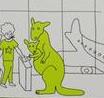
Wako University’s airport kangaroo and joey.
What we learned from this is that people on the borderline of being a man or woman are not decided naturally, but can change if society concurs with that. If we change our conceptions of what constitutes gender, we’ll no longer see our lives or experiences bound by perceptions of what a “man” or “woman” should be and become that kind of society where anyone can live.
Thinking about what gender is can provide an opportunity to change society.

The Original Text on the Train Carriage Poster
「性別は、生まれたときから決まっている。そんな常識は変わりつつあります。その好例がオーストラリアのパスポートです。「男」と「女」という性別の他に”X”という選択肢がつくられました。性的マイノリティの主張を受けたこの変更により、性別表記と外見が異なるために入国審査で煩わしい思いをするも減ったようです。
 ここからわかるのは、男女のボーダーラインは、自然と決まることではなく、社会の合意で変わりうるということ。「性別」の捉え方が変われば、「女」か「男」かによって人生や経験がしばられることもなくなり、誰もが生きやすい社会になっていくはず。
「性別」のあり方を考えることは、社会を変えるきっかけにもなるのです。」

Cop A Gander At These Rippers Too...

  • Laudable by Libs (Outside of Office) and Skillful Journalism

    For much of my life, I was something of a political animal, tempered by social requirements, but eventually tamed and then driven into apathy by circumstance. However, given a chance this week to watch a series of brilliant documentaries about Australian politics with a Tokyo connection, I felt stirrings of an old flame. Mark Willacy, a journalist for the Australian Broadcasting Corporation who was based in Tokyo as its North Asia correspondent from 2008 to 2013, interviewed more than 60 current and former Australian politicians for the three-part documentary series, Nemesis, that aired over the past couple of weeks and told the story of Australia’s three Liberal Party of Australia…

  • Indigenous Aussies and Strine 先住民と豪語

    Indigenous Australians have contributed richly to language on a global scale. This is especially through the names of creatures such as the kangaroo, koala, wombat, wallaby and dingo, all of which were originally Indigenous Australian words, but now used everywhere English is spoken, as well as being incorporated into other languages, including Japanese.  オーストラリア原住民の言語は、世界的にも貢献している。カンガルー、コアラ、ウォンバットやディンゴなどの動物の名前は全て先住民語に由来し、現在は英語だけでなく日本語を含め世界各国で使われており、まさに「国際語」だ。

  • オリンピック開会後、これから豪英スポーツ相対決

     2012年ロンドン五輪開会式が27日行って世界を魅了して、これからオーストラリアとイギリスの伝統的なオリンピック対決が始まる。  帝国と元植民地というライバル意識から生まれた好意的な対決は直接選手同士で行うということより豪ケート・ランディ氏と英ヒュー・ロバートソン氏各国のスポーツ大臣同士の対決だ。どちらの国のメダル数が多い方が勝ちだということだ。伝統的にスポーツ大国オーストラリアが勝場合が多かったが前回2008年北京五輪のメダル争いでは、英国が4位でオーストラリアは6位だった。しかし、その後、英国連邦に属する国や地域が参加して4年ごとに開催される総合競技大会であるコモンウェルス・ゲームズの2010年インド大会では1位のオーストラリアが3位のイギリスの総メダル数が約倍だった。  今回の豪英メダル争いは、負けるスポーツ相が罰ゲームがある。メダル数でイギリスが少なければロバートソン氏が豪ホッケーチームのシャツを着て、ロンドン中心部でドリブルしなければならないという。逆にオーストラリアが負ければ、ランディ氏が英デザイナー、ステラ・マッカートニーのユニオンジャックTシャツを着て、五輪のカヌー競技会場でボートをこぐという。  さて、どっちが勝つだろう?オリンピックが続く8月12日まで結果がお楽しみに。

  • The Lucky Country

    Australia is often referred to as “the lucky country,” which most people use favorably, but was actually a derogatory term coined by journalist Donald Horne in his book of the same name, and with April 25 a landmark date in Aussie history now called ANZAC Day, it got me thinking about fortune and the role it plays in lives. Australia had the misfortune to fight its first day of war as an independent, federated country on April 25, 1915, and thousands of young men were brutally mowed down in meaningless slaughter in the ill-fated Gallipoli campaign of World War I (having been escorted to the battlefield by our erstwhile Japanese…