Kangaroos Played a Part in Germans Being Big in South America BEFORE World War II
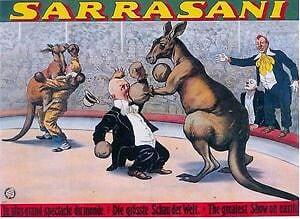
Postwar South America became somewhat notorious as a haven for Germans fleeing the defeat of the Third Reich in World War II, but some Teutonic types had already made it big in Argentina before the Nazis…and kangaroos had something to do with it, albeit an extremely minor role.

Kangaroos served as an advertising figure for Sarrasani, a world-famous German circus between the wars. Sarrasani was formed in the German city of Dresden in 1901 by Hans Stosch, a clown with the stage name Giovanni Sarrasani. The circus was best-known for its elephants, but also employed lots of “exotic” peoples such as Japanese, Javanese and Sioux Native Americans, as well as the then rarely seen marsupials.

The circus boomed throughout the 1920s, when Sarrasani also wrote pulp fiction cowboy stories. Stosch’s son, also Hans, ran the circus until his death in the early 1940s and was succeeded by his widow. The Sarrasani circus was destroyed by the Bombing of Dresden in 1945.

Trude Stosch-Sarrasani re-established the circus in Argentina in the 1940s, even calling it the Argentinean National Circus to appease nationalist Peronistas at one stage.

The circus returned to Germany following German reunification in 1990 and continues to operate.

Cop A Gander At These Rippers Too...

  • | |

    我輩は日豪パイオニアである:日本の心を掴んだオージーぼっちゃん

    教師でもあり歴史家でもあるジェームス・マードック氏は、その生涯の多くの時間を日本とオーストラリアで過ごした。 ヴェルサイユ条約(パリ講和会議)に於いては、白豪主義真っ只中の豪州国内で、日本が提案した議題、人種的差別撤廃の数少ない支持者であったが、結果的には同条項は採択されなかった。 James Murdoch, a teacher and historian who spent much of his life in Japan and Australia, fought an ultimately losing battle as one of the few supporters in White Australia of Japan’s proposed equality clause in the Treaty of Versailles.

  • The First Class First Nations Film Festival

    For a measly 1,000 yen I got to get a totally unexpected and delightfully amazing full day’s entertainment, a couple of souvenirs and an all-round wonderful time at the 2024 First Nations Film Festival held by the Australian Embassy in Tokyo at EUROSPACE. I’ve always been sympathetic to the cause of Indigenous Australians as I’ve understood it, but in recent years I’ve developed a bit of empathy fatigue, or even borderline antipathy, as the blame for society’s shortcomings are increasingly laid at the feet of all white men. So when Mrs. Kangaeroo expressed an interest in going to the festival after seeing an ad on Facebook, I wasn’t overly keen,…

  • Koala-ified for Cuteness

    Koalas are a gorgeous symbol of Australia. Contrary to a once-popular belief, the koala is not a bear. It is, in fact, a marsupial, most closely related to the wombat and kangaroo than it is to anything ursine. Back in the mid-1980s, koalas set off a frenzy among Japanese when they were first brought to zoos here. Like the country itself, though, Japan’s koalas are aging and the country’s koala population has dwindled below half of its peak in the late 1990s. Koalas generally sleep for 22 hours a day, so the animals in these photos are essentially in action pics. It’s fair to say that for most Japanese who…

  • Commo

    Commo is Strine for communist, either a person, the ideology, or an adjective. It reflects the Strine tendency to use the diminutive form. Commie is also used. Commo はストラインで“共産主義者”を指す言葉で、人そのもの、思想、あるいは形容詞としても使われます。ストライン特有の縮小形(短縮形)を好む傾向を反映した表現で、commie という形も使われます。

  • Spruik/カラス族

    Spruik Australian English To advertise or promote a service or product. Somebody who does this is a spruiker. The name is also given to street-side touts who try to entice people into clubs, restaurants or other entertainment establishments. 日本語 1) 製品及びサービスを推薦・促進すること。この行為を行う人はspruikerと呼ばれる。 2) Spruikerは、バーかクラブやレストランなどをしつこく売り込む人に対して使われることもある。日本の繁華街などで集まる「カラス族」もオージー英語ではspruikerと呼ばれるはずだ。 Plain English To plug, tout, harangue or sell and promote aggressively. Strine Dictionary