Acrobatic Start to Relations まさにアクロバティックに始まった日豪関係

知られざる日豪関係のルーツ What You Didn’t Know about Australia-Japan Relations
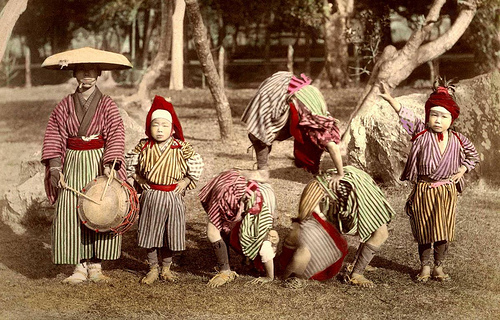
Meiji-era (1867-1912) Japanese Acrobats

日豪関係のルーツは、まさにアクロバティックに始まった。1867年に日本の曲芸団がオーストラリアを訪問した数年後(具体的な日付は不明。1871年という説もあれば、1874年という説もある)、Sakuragawa Rikinosukeという曲芸師がオーストラリア人女性と結婚して、豪州に移住した日本人として初めて記録された。

Japan-Australia relations started off by swinging into action – literally. First contact came in 1867 when a Japanese acrobatic troupe visited Down Under in 1867. A few years later (the exact date is unknown – some say 1871, others 1874), Rikinosuke Sakuragawa, an acrobat touring Melbourne with another troupe, married an Australian woman and they settled in Queensland, where their descendants remain today.

Sakuragawa夫妻がメルボルンで出会い、以降クィーンズランド州に移り、今でも卑属が住み続けている。同氏に続き日本人のオーストラリアへの移民が始まった。1901年に執行された白豪主義前の日本人のオーストラリアへの移民ピークが19世紀末の1893年から1898年の間だったので、僅かの約3500人に止まった。

Sakuragawa was the first recorded Japanese resident of Australia. He would herald pre-White Australia Policy Japanese migration that peaked from 1893 and 1898, when about 3,500 people settled.

ちなみに、Sakuragawa氏があの「不思議な国のアリス」作家であったルイス・キャロルのために演じた可能性がある。

Incidentally, Sakuragawa is also rumored to have performed for Lewis Carrol, author of “Alice in Wonderland.”

あなたがご存知の”知られざる日豪関係”についてのお話はありませんか? ご存知の話がありましたら、”考えRoo”の読者にシェアしていただけませんか? 是非、お知らせください。お待ちしています。
Do you know something about Australia-Japan relations that most people don’t? Want to share it with Kangaeroo’s readers? Please let us know.

Reference/参照
The Japanese-Speaking Community in Australia
(Anti-)Cosmopolitan Encounters
Japanese People Lewis Carroll Saw
The Japanese Community
Japan-Australia Relations
Cop A Gander At These Rippers Too...

  • Daks/ズボン

    daks Australian English When used in its noun form, daks refers to trousers, but as a verb, to “dak” someone means to pull down their trousers by surprise. 日本語 1) (名詞)ズボン 2) (動詞)いきなり人のズボンを下に引っ張ること。 Plain English 1) (n) Trousers. 2) (v) To suddenly pull down someone’s trousers. Strine Dictionary

  • Arse Wind?

    Walking along Route 246, I was surprised to look up and see the katakana script reading アースウィンド!  びっくり仰天だった! アースis, in English, arse…or, so I thought. Arse wind, then, could only mean one thing….surely a company couldn’t have named itself after a fart? Of course it didn’t. In fact, アース is also the reading for earth. That makes Earth Wind a little easier to comprehend, even if the English is still a little awkward.

  • |

    Waltzing Matildas In The Land Of The Rising Sun

    Waltzing Matilda is probably Australia’s most famous song and it’s certainly a tune that remains powerfully iconic of Down Under, but has not had the impact in Japan of other Aussie tunes, like say, Click Go the Shears. That’s not to say that Matilda hasn’t made it’s mark. However, like many things Japan, it’s legacy lies not quite in the way you’d expect. My understanding is that Waltzing Matilda is probably best known in Japan for being the jingle used to open Japanese language shortwave radio broadcasts on Radio Australia, which ended in 1990, so there’s a fair chance that my guess is well out of date. Three-piece rock band…

  • |

    「やばいリンガル」Heaps (山積み)

     もの・ことを積み重なると米・英語ではheapを使えるが、豪語ではheapになると意味が違ってくる。どのように変えるか見て見よう。 Differences between Strine and English as it’s spoken in other parts of the world can simply make some collapse into a heap…unless they’re Down Under, where “heaps” carries a different meaning.

  • Own Your Own Japanese Castle for $100,000

    Aussies can buy an (almost) authentic Japanese castle for only about $100,000, it has been revealed recently on social media. Century21 Japan is selling the 6-story castle (with a restaurant on the second floor) in Akabira, Hokkaido, at a price unimaginable to potential home buyers Down Under. Of course, at that price, there’s bound to be a few catches, but perhaps not as many as some may think, especially considering it comes with a huge garden (over 5,000 m2), a working elevator, restaurant, more than 40 parking spaces and connection to sewage and water mains. Located in Hokkaido, Japan’s northernmost island and home to the cashed-up bogan paradise of Niseko,…