A Breakout Performance Focusing on Australia’s Cowra
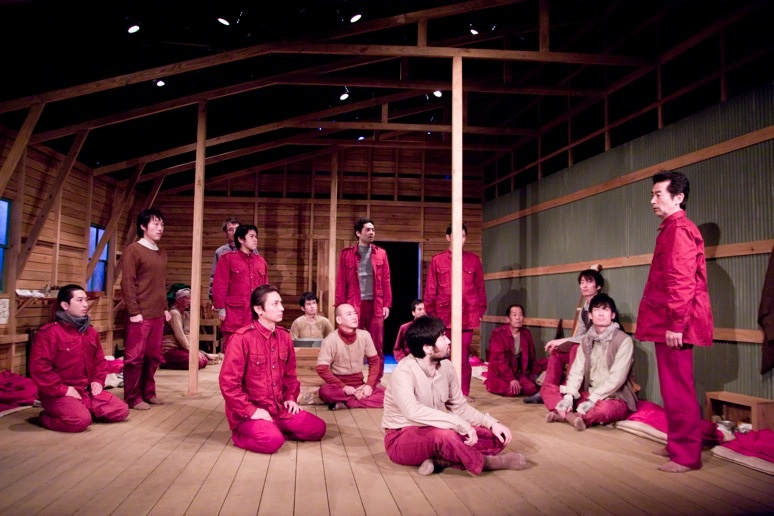
A scene from "Kaura no Hancho Kaigi" with Japanese POWs wearing the crimson uniforms they wore at the Cowra Prison Camp.
A scene from “Kaura no Hancho Kaigi” with Japanese POWs wearing the crimson uniforms they wore at the Cowra Prison Camp.
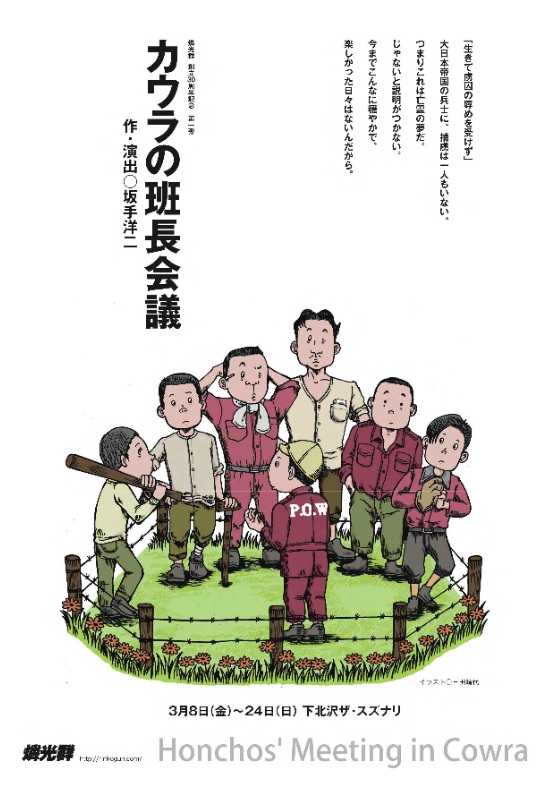
Kaura no Hancho Kaigi (Honchos’ Meeting in Cowra) superbly dramatizes events surrounding a definitive incident in Australia-Japan relations.
The play being performed by the Rinkogun theater group daily until March 24 (with two shows on March 19 and 21) centers on the Cowra Breakout, an attempted escape by about 550 Japanese prisoners of war being held in an Australian POW camp in August 1944.
Interwoven with the action surrounding the decision to rebel and attempt to escape or die trying by a group of men whose own homeland had effectively killed them by bureaucracy and cultural manipulation is a tale of a group of women making a film about the incident, but also containing a sub-plot of documenting the Fukushima nuclear disaster.
Overall, the result is a must-see for anyone with an interest in Australia-Japan relations, though it may not be exclusively pleasing and could raise discomforting issues that can sometimes be shoved under the carpet, prime of which is the fact that Australia and Japan were once at war and bitter, racially opposed enemies: a matter not commonly known in Japan.
HonchoLargeThe play is also an unabashedly left-wing account of events, but this is also Kaura no Hancho Kaigi’s greatest strength as it humanizes the characters, notably the Imperial Japanese Army soldiers whose wartime culture depended on their dehumanization.
Playwright Yoji Sakate‘s script admirably addresses many serious issues, but perhaps too many, and sacrifices clarity at times in an apparent effort to ensure all sides have their views presented, but this foible is only a minor one.
Made for a Japanese audience, Kaura no Hancho Kaigi is essentially a Japanese-language play, but has large swathes of English (sometimes for mysterious reasons), much of which is delivered with deplorable Australian accents by American actors John Oglevee and Benjamin Beadsley, who redeemed themselves by breaking the fourth wall to apologize for their Strine deficiency.)
Nontheless, the somewhat surreal play had a bit of everything from action, humor, tragedy and drama, and is certainly worth seeing.

カウラの班長会議Kaura no Hancho Kaigi (Honchos’ Meeting in Cowra)
All seats reserved (prices range from 1,500 to 4,000 yen)
Showing until Sunday, March 24 at Shomokitazawa Za Suzunari
For inquiries or ticket sales, contact Rinkogun
(All inquiries should be made by a Japanese speaker)


Cop A Gander At These Rippers Too...

  • |

    豪キャブラリー: Pissed

    オーストラリアの飲酒文化が深く、近所でバーベキューを頻繁に開き、日本などに比べて娯楽施設が少ないので、暇があると酒を飲む人が少なくなくpissedとなる場合が多い。他の英語圏の国ではpissedは主に「怒る」と言う意味だが、オージー英語ではその意味の上にもっとよく使われているのは「泥酔状態」を示すとしての言葉だ。考えてみれば、泥酔状態だと怒りが共通となる場合が多い。ところで、ノンべは、pissheadとも言う。ちなみに、pissedは、不敬な言葉なので、使うに気を付けましょう。

  • Icky

    オージー英語であるストラインでは「Icky」は難しい場面や状態という意味だ。居心地の悪い場所や環境の意味もある。

  • |

    …ah, so* have a Winfield: The Tiny Tale Of Aussie Durries In Japan

    A long, long time ago, in a Straya far, far away, Australia briefly exported cigarettes to Japan.It wasn’t that long ago, actually.But for several months in 1994, Winfield cigarettes, one of Australia’s most famous brands (it marketed itself as “Australia’s No. 1 brand” in Japan, but it was actually only the second-biggest seller Down Under, behind Peter Jackson), was an unlikely competitor of mostly British and American Big Tobacco companies to tap into what was still then a thriving Japanese smokers’ market largely unregulated at the time.Winfield was on a downturn at the time in its home country.Cigarette advertising had been banned from TV and print media decades earlier, but…

  • |

    豪キャブラリー:Mongrel

    Mongrelの意味がオージー英語ではたくさんあるが、今日の場合は「短期」や「怒りっぽい」に集中しよう。 Mongrelの由来は雑種犬という意味だ。良い風に言うと「ガッツ」とか「負けず嫌い」というような感じを示すが、悪くいうと「頼りにならない」ような意味もあり、褒めるも軽蔑もどちらかに使えるので、そういう意味では特に役に立つ言葉のひとつかもしれない。しかし、ほとんどの場合、言われたら嬉しくない言葉だね。

  • |

    レストランの「BYO」とは?

    What Is A Restaurant BYO? Imagine walking into a restaurant carrying a bottle of wine. In many countries, you’d be stopped at the door. In Australia? You might be thanked. A restaurant marked BYO means Bring Your Own alcohol. Many smaller restaurants don’t have a liquor licence. Instead of losing customers, they invite diners to bring their own beer or wine. The restaurant usually charges a small corkage fee to provide glasses and open the bottle. It’s a particularly popular tradition at family-run Asian restaurants, where bringing your favourite bottle has become part of the dining experience. Vocabulary ExpressionBYO Pronunciation/biː waɪ əʊ/ MeaningBring Your Own (usually alcohol). Example “Don’t forget—it’s…

  • Gobful, give a・怒る

    gobful, give a Australian English To get verbally abusive or angry at somebody. “Gob” means “mouth.” In informal situations, the two words are interchangeable in Australian English. 日本語 怒る。言いつける。叱る。Gobは、mouthと同意味。気楽で話せる場面なら、豪語ではどっちらを使っても構わない。 Plain English 1. To admonish. 2. To give somebody a mouthful. Strine Dictionary