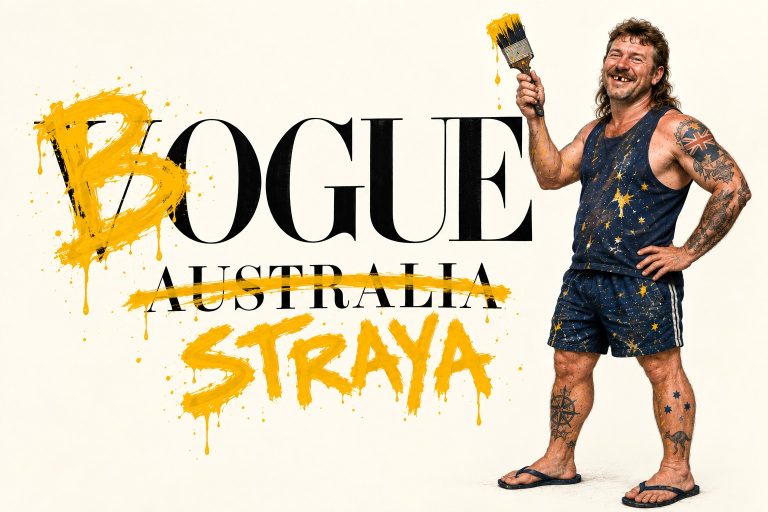
Boganism And The Aussie Class System

This may actually be the deepest subject behind the whole phenomenon.
Australia traditionally likes to imagine itself as an egalitarian society where the wealthy and working class can sit together in the pub and have a beer.
Consequently, Australians have historically been uncomfortable talking explicitly about class.
“Bogan” provides a sneaky alternative.
Instead of saying:
“That person is working class.”
people can say:
“They’re a bit bogan.”
Instead of saying:
“I dislike their cultural tastes.”
they can say:
“That’s bloody bogan.”
Sociologists Steve Threadgold and Jessica Gerrard have argued that figures such as the bogan and the hipster function as proxies for class in Australian public culture. The bogan represents supposedly vulgar working-class tastes, while the hipster represents a more middle-class cultural aesthetic.
Chris Gibson’s research into “Bogan-ville” similarly found that the label can generate both class stigma and local pride. Communities labelled bogan sometimes respond by embracing the label rather than accepting the insult.
That gives us a fascinating contradiction:
Bogan as insult
“You’re uncultured.”
Bogan as defence
“Yeah, so what?”
Bogan as boast
“I’m proud of it.”
Bogan as national identity
“That’s what real Australians are like.”
That’s a remarkably sophisticated cultural evolution for a four-letter insult.