The Times, They Are A Changed

Imagine this today? No way!

Japan will finally re-open its doors to unrestricted travelers in October 2022, over 2 1/2 years since imposing strict entry requirements (especially on foreigners) due to the COVID-19 pandemic.

With the yen at its weakest against most major currencies since the early 1990s (and effectively even weaker still in real terms as the yen of the early 1990s carried far greater purchasing power than the yen of the 2020s), tourists are predicted to flock back into Japan.

Japan is one of the world’s great tourist destinations and it is Kangaeroo’s belief that the hospitality of many Japanese people show toward tourists make it this way. Japan has an extremely well-deserved reputation for being hospitable toward visitors, and that was also Kangaeroo’s experience.

People are expected to come to the Japanese wonderland to see such treats as the mix of ancient and modern traditions, the neon-lit cities, the amazing food, incredible trains, anime, manga, J-Pop and all sorts of delights.

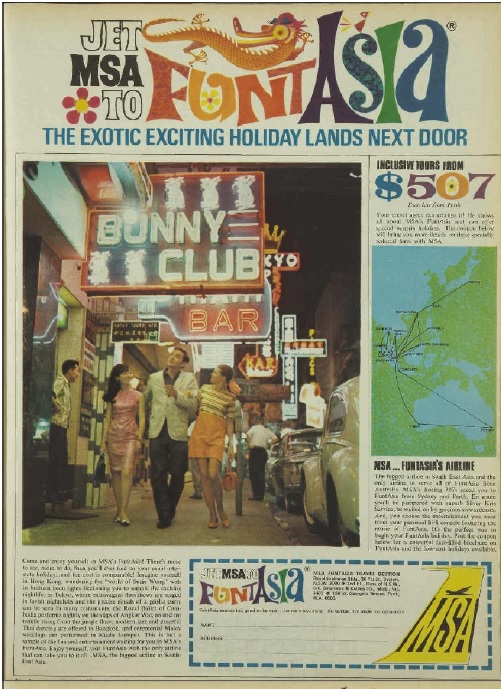
Not a tourism ad, but an example of the exoticism and sexualization used to deal with Japan in the olden days when Boomers were still young

Things have kinda changed since Kangaeroo first came here, though. In those days, the selling point was the exoticism of Japan, especially its women, and the marketing was highly sexualized in a manner unthinkable in today’s prissy age of political correctness. Back in the day, Japan was plugged as being the homeland of topless pearl divers and geisha girls.

MSA Airlines, the forerunner of today’s Singapore Airlines and Malaysian Airlines, tried in an October 1968 advertisement to entice tourists to the Land of the Rising Sun by saying, “Imagine yourself…in Tokyo, where extravagant floorshows are staged in lavish nightclubs and the precise rituals of a geisha part can be seen in many restaurants.” Imagine yourself nowadays if you tried to sell travel with a line like that? (Or even worse, what they said about Hong Kong, where you could be: “Wandering ‘the world of Suzie Wong’ with its brilliant neon lights beckoning you to sample the exciting nightlife.” Definitely a case of mixing up what’s Wong and what’s right.)


Cop A Gander At These Rippers Too...

  • A Model Day

    Despite the icy midwinter temperature, Tokyo was gloriously sunny today. Regardless of the day, I try to walk as much as possible. Today’s reward was getting to see a gorgeous model having her photo taken!

  • 豪州10月「お花見」人気過剰となり中止に追われた

     オーストラリアメルボルン市にあるオリンダの豪国立シャクナゲ園内恒例イベントである「お花見」の人気があり過ぎて、地域のインフラに過剰な負担を理由に2014年版、とビクトリア州公園局が発表した。 季節が日本と反対南半球では今春がやってきた所であり、毎年この時期になると同園がビクトリア州豪日協会により「お花見」を行う。  しかし、昨年、一日だけ行う「お花見デー」が驚くほど人気であって、小さな町の一角にある同園にいきなり約1万7千人がやってきたのでインフラがパンク状態になったという。  そこで、今年の「お花見」イベントを中止することにした。残念だね。しかし、これもオーストラリアでも日本人気が上昇していると受け取っても良いと思う。 オーストラリアでの花見をお楽しむのが9月!

  • 「Put A Sock In It」と言われたら何で黙った方がいいの?

    Why Would It Be Better To Shut Up If Someone Tells You To Put A Sock In It? Put a sock in it is a classic Strine expression meaning “Be quiet!” or “Shut up!” 日本語の意味 Put a sock in it は「黙れ!」「静かにして!」という意味です。 Explanation Australians usually say it jokingly between mates, not as a serious insult. 日本語での解説 友達同士で冗談っぽく使われることが多い表現です。 Example “Put a sock in it, mate! I can’t hear the telly.” 日本語訳 「ちょっと黙ってよ。テレビが聞こえないよ。」 Strine Culcha Strine often sounds blunt, but it’s usually meant with humour. オージー文化メモ ストライン(オージー英語)はぶっきらぼうでも、親しみを込めて使われることがよくあります。 Related Terms

  • Gonna Be A Great Year

    Hard to believe we’re a month into the halfway point of the 2010s. It’s been a great start. Work is challenging and enjoying. But I really love the people I work with. And the company I work for is also great. I also get to wander through the streets of Aoyama during breaks. It’s an awesome area to work in. Rei Ozawa told me she would love to work around here. I was hesitant at first, but now I understand why. My workmate arranges Wednesday team lunches at a different nearby restaurant every week and it’s absolutely awesome.

  • |

    豪のクリスマス・ソング:Aussie Jingle Bells

     オーストラリア版のジングル・ベルがあったのは知ったか?あるんだよ!  「ジングル・ベル」が雪の中のソリを乗っている話だが、真夏のクリスマスがあるオーストラリアでは雪もソリもない(実は、いずれもあるが、それだと話がうまくまとまらないので、とりあえず、別に置いておこう。)  オージー版のジングル・ベルズは田舎道で走る豪産者ホールデン社のピックアップ・トラックの話。  先日考えRooで掲載されたDeck the Shedの作詞・作曲バッコ&チャンプスことグレグ・チャンピオン氏とコリン・ビュキャノン氏の作品だ。 AUSTRALIAN JINGLE BELLS Dashing through the bush, in a rusty Holden Ute, Kicking up the dust, esky in the boot, Kelpie by my side, singing Christmas songs, It’s Summer time and I am in my singlet, shorts and thongs Oh! Jingle bells, jingle bells, jingle all the way, Christmas in Australia on a scorching summers day, Hey! Jingle bells, jingle bells, Christmas time is beaut! Oh what fun it is to ride in a rusty Holden Ute. Engine’s getting hot; we dodge the kangaroos, The swaggie climbs aboard, he is welcome too. All the family’s there, sitting by the pool, Christmas Day the Aussie…