The “Bento Bogan”

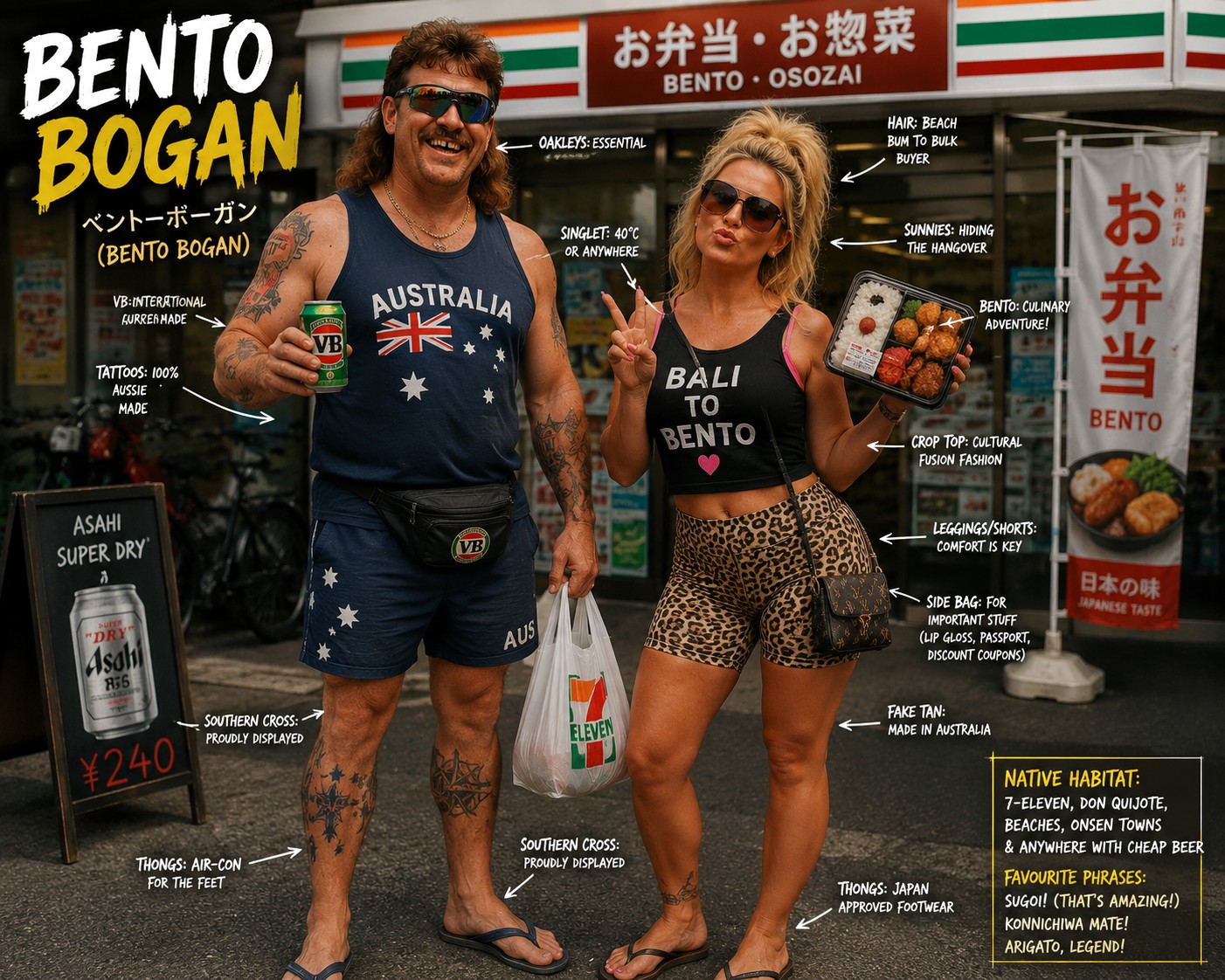
Australia’s tourism boom in Japan has produced a new stereotype of the Australian tourist in Japan.

Some Australian commentary has started jokingly referring to this phenomenon as the boganisation of Japan.

The background is real: Australian arrivals to Japan surged after the pandemic, helped by Australia’s proximity to Japan, favourable exchange rates and Japan’s enormous appeal as a destination.

One 2025 report noted that Australian visitors to Japan reached 637,300 between January and September 2024, up 42% on the equivalent record period in 2019.

And some Australians have begun joking about a new breed:

The Bento Bogan

A person who has somehow transported from Bali to Japan the cultural package of:

  • beer;
  • loudness;
  • thongs;
  • tattoos;
  • footy;
  • excessive confidence;
  • “she’ll be right”;
  • and questionable public behaviour

Cop A Gander At These Rippers Too...

  • The Dark Side Of The Bogan

    It would be a mistake to romanticise the phenomenon completely. “Bogan” can be profoundly classist. It can function as a respectable-sounding way of insulting: And stereotypes associated with bogan culture can also include: But these aren’t inherent characteristics of every person labelled bogan. That’s precisely why the term is so slippery. One academic analysis calls “bogan” a “sticky sign” because it can simultaneously attract contempt, affection, identification and disidentification.

  • Cars: Probably The Greatest Bogan Art Form

    If you wanted to identify one area in which bogan culture becomes genuinely subcultural, I’d choose cars. Particularly: Australia developed a particularly distinctive form of working-class car culture around the Holden–Ford rivalry. The ute is especially significant. It is simultaneously: work vehicle + family vehicle + status symbol + masculine identity + recreational toy. And then there is the Australian phenomenon of the hoon. The hoon and the bogan aren’t identical, but they overlap heavily.

  • Bogan Culture: A Cultural Report

    Executive summary The first thing to understand is that “bogan” is not really the name of a single, coherent social group. It is a remarkably flexible Australian cultural label. At various times it has meant: That last transformation is probably the most interesting. “Bogan” began largely as an insult but has been partly reclaimed as a badge of authenticity, national identity and resistance to cultural snobbery. Linguist Roslyn Rowen describes it as a distinctive Australian cultural keyword whose negative meaning can be transformed into positive self-identification and Australian nationalism. And there is a delicious paradox at the heart of it: The bogan has become fashionable precisely because the bogan is…

  • Bogan Moths. Nah, You Heard It Right. The NSW Swarm Is Not Bogong Moths

    聞き間違いじゃないぞ! NSW州で大発生しているのはボゴンガじゃなくてボーガンガだ! Recent reports have suggested that endangered bogong moths have been swarming part of the Aussie state of New South Wales, but closer inspection has revealed that the infestation has actually been of bogan moths. オーストラリアのニューサウスウェールズ(NSW)州の一部で、絶滅が危惧されるガ(蛾)の一種、ボゴンガ(Bogong moth)が大量発生しているとの報道が流れていた。ところが、よくよく調べてみると、そこらじゅうに出没していたのはボゴンガではなく、なんとボーガンガ(Bogan moth)だったことが判明した! The bogan moths are apparently targeting ciggies, people’s fridges and whatever else they can gather. そんなボーガンガたちの今回のターゲットは、どうやらタバコ(ciggies)や他人の冷蔵庫、その他、かき集められるものなら何でもありらしい。 Bogan moths are reported to be extremely aggressive. しかも、やたらと攻撃的だというからタチが悪い。 Authorities remain searching for the bogan moth swarm, but have little confidence in being able to eradicate it. 当局は今もボーガンガの大群を捜索中。しかし、根絶できる見込みは薄いと、すでに弱気になっているようだ。 Bogong moths derived their name from an Australian Aboriginal language; the Dhudhuroa word bugung describes the brown colouration of the moth. They were a source of food…

  • |

    Gangnam Bogan Style! K-Pop大ヒットの豪ダサイ風パロディ版が注目を浴びている

    今、韓国K-PopアーティストPSYの「江南スタイル」が世界中に大ヒットが、数多くのパロディ版も発表され、その中オージーのダサイ文化を称える「ボーガン」風のMelbourne Styleが注目を浴びている。 K-Pop artist PSY may have scored a massive global hit with his catchy Gangnam Style, but he’s also inspired plenty of parodies, including Gangnam – Melbourne Style!, a version that celebrates Australia’s bogan culture of the unfashionable. ちなみに、元の「江南スタイル」がこうだ。 Incidentally, the original Gangnam Style is here.  ビデオの独特なダンスがヒットの原因一つとしているが、日本のネット社会では日本のカー用品販売「イエローハットCMのパックリだ」という声も上がっている。そのビデオがここにある。どう思う? The dance mimicking a lasso-wielding horse-rider in Gangnam Style is often cited as a source of the hit’s success, but some among Japan’s Net community say PSY has ripped off moves from an ad produced here years ago by Yellow Cab, a car accessories seller. That video is here. What do you reckon?

  • | | |

    Is Niseko Still Australia’s Ski Town?

    ニセコは今も「オーストラリア人のスキーの町」なのか? Walk through Niseko today and you’ll hear conversations in Japanese, English, Mandarin, Korean and many other languages. The resort that Australians helped introduce to the world has become one of Asia’s most international winter destinations. Visitors now arrive from across the globe, while investment comes from many countries. So, after more than three decades, is Niseko still Australia’s ski town? 現在のニセコを歩くと、日本語だけでなく英語、中国語、韓国語など、さまざまな言語が聞こえてきます。 かつてオーストラリア人が世界に紹介したスキーリゾートは、今ではアジアを代表する国際的なウィンターリゾートへと成長しました。 では、30年以上が経った今でも、ニセコは「オーストラリア人のスキーの町」と言えるのでしょうか。 The Pioneer Years There was a time when Australians dominated Niseko’s international tourism scene. From the mid-1990s through the early 2000s, Australian visitors arrived in growing numbers, opening cafés, ski schools, accommodation businesses and tour companies. Their enthusiasm encouraged more travellers to discover Hokkaido’s famous powder…