Zenshoen, A Story Of Cruel Tragedy
All sorts of memories flooded back to me during a brief ride through Tama Zenshoen, a gorgeous park in outer western Tokyo, but also home to a tragic and cruel past for Japan’s Hansen’s disease patients.
Zenshoen is a leprosarium and for most of its history, the 115-year-old facility was shut off from the rest of the world and its inhabitants quarantined inside, sterilized and forbidden from associating with the outside world, largely based on 1951 testimony to the Diet by Kensuke Mitsuda, a staunch segregationist but also unfortunately Japan’s foremost expert on leprosy at the time.
This continued for decades, even after it was known that Hansen’s disease was curable, not easily contagious, and did not need to be a disease to prevent those living with it from living normal, healthy lives.
Japan enacted the Leprosy Prevention Law in 1953, under which Hansen’s disease patients were placed under isolation. They would remain shut away from the world until 1996, when the country’s leprosy-related laws were finally repealed. (Hansen’s disease patients would later take a class action against the government for abuse of their human rights and in 2001 be awarded fairly trifling sums <maximum compensation of 14 million yen.>)
I first visited Zenshoen in 1995 when I was a cub reporter. The wire gates around the compound, one of a about a dozen leper colonies still existing in Japan at the time, were huge. There are schools and hospitals on the grounds, so traffic in and out was not uncommon, but not welcoming, either. A story I wrote on Zenshoen back then would be one of the first I ever penned for payment. I thought I had a copy somewhere, but it seems gone.
Most of my interviews over several visits were conducted with a man called Yasuji Hirasawa. I found his experiences heart-breaking. One of the things Hirasawa said that remained in my memory was his strong desire for Zenshoen to be converted into a park so that as many people as possible could go inside and visit and see what it was like. He said that people were so hungry for company after having been shut away for so long that they desperately wanted others to come and see them.
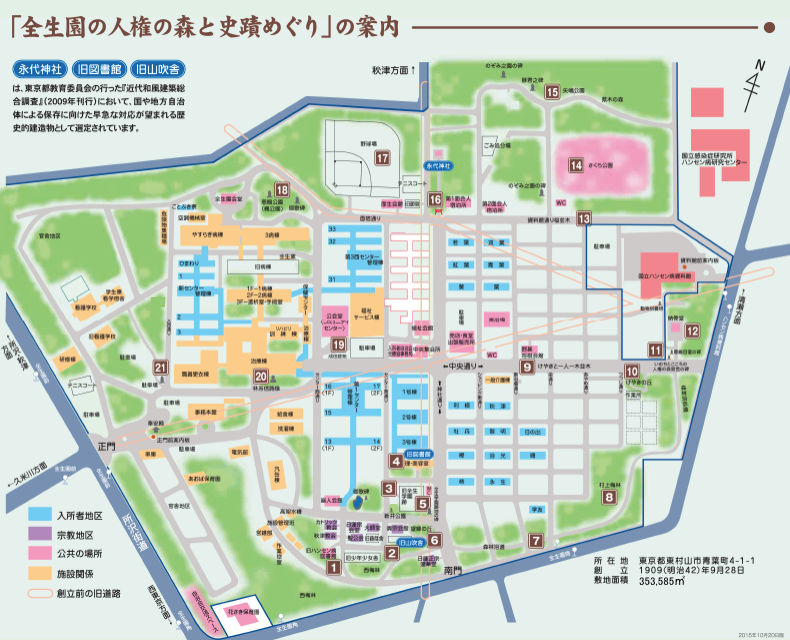
Yesterday, the visit wasn’t the prime reason for being there and we could only spend a short time inside the grounds. It was the first time I had been there since 2011 and I was a little shocked. At that time there had still been a few hundred residents and they all lived in little huts. They formed a decent-sized village laid out into a grid schematic. Now, only a few huts are left, which I took to mean that most of the residents have passed away. Most were elderly when given their freedom in 1996, so it did not come as a surprise. Hirasawa, it seems, may still be alive. The most recent report I can find about him dates to 2023, when he was 97. He was slated to be a torch-bearer for the ill-fated 2020 Tokyo Olympics. He was proactive in telling the tale of Zenshoen and the Hansen’s disease experience in Japan. The National Hansen’s Disease Museum is located next to Zenshoen and contains video testimony from Hirasawa and other patients, as well as extensive documentation of the facility.
But, I digress…this post was only supposed to be a short note touching on some long distant memories, but having gone down the rabbit hole, it could go on forever.
The sanatorium’s pristine cleanliness and idyllic surroundings reminded me of The Village in the TV series, The Prisoner. And it also shared that village’s fate of its inhabitants being unable to leave. That doesn’t mean to trivialize what the people of Zenshoen went through. It is only intended to offer an example of the bizarre and cruel existence that was forced upon them that no amount of beauty in its facade could cover up. Tama Zenshoen is an extraordinarily beautiful place. But it also has an extremely sad and ugly past.