Acrobatic Start to Relations まさにアクロバティックに始まった日豪関係

知られざる日豪関係のルーツ What You Didn’t Know about Australia-Japan Relations
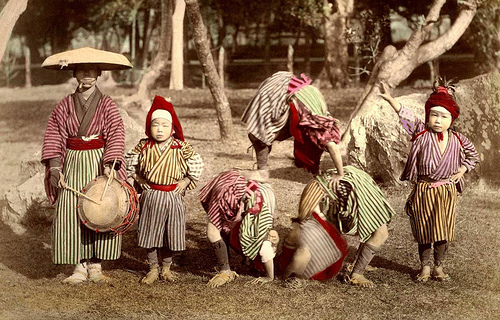
Meiji-era (1867-1912) Japanese Acrobats

日豪関係のルーツは、まさにアクロバティックに始まった。1867年に日本の曲芸団がオーストラリアを訪問した数年後(具体的な日付は不明。1871年という説もあれば、1874年という説もある)、Sakuragawa Rikinosukeという曲芸師がオーストラリア人女性と結婚して、豪州に移住した日本人として初めて記録された。

Japan-Australia relations started off by swinging into action – literally. First contact came in 1867 when a Japanese acrobatic troupe visited Down Under in 1867. A few years later (the exact date is unknown – some say 1871, others 1874), Rikinosuke Sakuragawa, an acrobat touring Melbourne with another troupe, married an Australian woman and they settled in Queensland, where their descendants remain today.

Sakuragawa夫妻がメルボルンで出会い、以降クィーンズランド州に移り、今でも卑属が住み続けている。同氏に続き日本人のオーストラリアへの移民が始まった。1901年に執行された白豪主義前の日本人のオーストラリアへの移民ピークが19世紀末の1893年から1898年の間だったので、僅かの約3500人に止まった。

Sakuragawa was the first recorded Japanese resident of Australia. He would herald pre-White Australia Policy Japanese migration that peaked from 1893 and 1898, when about 3,500 people settled.

ちなみに、Sakuragawa氏があの「不思議な国のアリス」作家であったルイス・キャロルのために演じた可能性がある。

Incidentally, Sakuragawa is also rumored to have performed for Lewis Carrol, author of “Alice in Wonderland.”

あなたがご存知の”知られざる日豪関係”についてのお話はありませんか? ご存知の話がありましたら、”考えRoo”の読者にシェアしていただけませんか? 是非、お知らせください。お待ちしています。
Do you know something about Australia-Japan relations that most people don’t? Want to share it with Kangaeroo’s readers? Please let us know.

Reference/参照
The Japanese-Speaking Community in Australia
(Anti-)Cosmopolitan Encounters
Japanese People Lewis Carroll Saw
The Japanese Community
Japan-Australia Relations

Cop A Gander At These Rippers Too...

  • Chunder/反吐

    chunder Australian English To vomit, throw up, regurgitate. Also called a “technicolor yawn,” or “driving the porcelain bus.” 日本語 反吐する。げろする。また、同意味としてtechnicolor yawn 「直訳:テクニカラーあくび」とdriving the porcelain bus「直:磁器製バスを運転する」使うこともある。 Plain English Throw up, heave. Strine Dictionary

  • |

    Macropod Music and Getting Sentimental Over Kangaroos in Japan

    Kangaroos and koalas are among the symbols Japanese pop culture has, for many and various reasons, adopted at times (the latter with particular relish), and singer Misato Watanabe‘s choice of subject topic for her 1988 hit Sentimental Kangaroo proved a marsupial masterpiece. Watanabe made her debut in 1986 with My Revolution, a huge hit that earned her a gold prize at the 28th Annual Japan Record Awards and would be the biggest-selling song of her career. Watanabe, whose heyday stemmed from the late ’80s to early ’90s, continues performing regularly today. Sentimental Kangaroo was one of the attempts she made to match My Revolution, one of Japan’s most-covered songs of…

  • 何でBaggy Green(バギー・グリーン)を頭にかぶっている?

    オーストラリアで最も価値のある帽子? オーストラリア人にとって、一番誇らしい帽子は何でしょう? アクブラハット? いえ、それ以上に特別なのが Baggy Green(バギー・グリーン) です。 これはオーストラリア代表としてテストクリケットに初出場した選手だけが授与される、濃い緑色の少しぶかぶかした帽子です。 新品でも決して格好いい帽子ではありません。しかし選手たちは、新しいものに交換せず、何年も同じ帽子を使い続けます。 試合を重ねるたびに色あせ、汗や泥で傷んでいく姿こそ、「国を代表して戦ってきた証」と考えられているからです。 Baggy Green は単なる帽子ではありません。 オーストラリアのクリケット文化そのものを象徴する存在なのです。 スポーツ用語 英語Baggy green 発音/ˌbæɡi ˈɡriːn/ 意味 オーストラリア代表テストクリケット選手だけに授与される伝統的な緑色のキャップ。 例文 He finally earned his Baggy Green. 「彼はついにオーストラリア代表としてバギー・グリーンを手にした。」 日本とのつながり 日本では高校野球の「甲子園の土」が特別な意味を持つように、オーストラリアでは Baggy Green が選手たちの憧れです。 高価なトロフィーよりも、一つの古びた帽子。そんなところにも、オーストラリア人が伝統を大切にする国民性が表れています。

  • |

    「やばいリンガル」 Thongs

     今、オーストラリアは真夏に向かっているので、町の中では多くのオージーがthong姿を見せてくれるようになる。しかし、それを他の英語圏の人に言ったら、彼らは顔を赤らめるだろう。何でだろう?オーストラリアでのThong姿は、全然恥ずかしくないのに。 It’s approaching midsummer in Australia and many Aussies would now be getting about in thongs. Tell that to someone from another English-speaking country and they may assume it would be a time for red faces. Why thongs? And why so embarrassing?