Green Godzilla

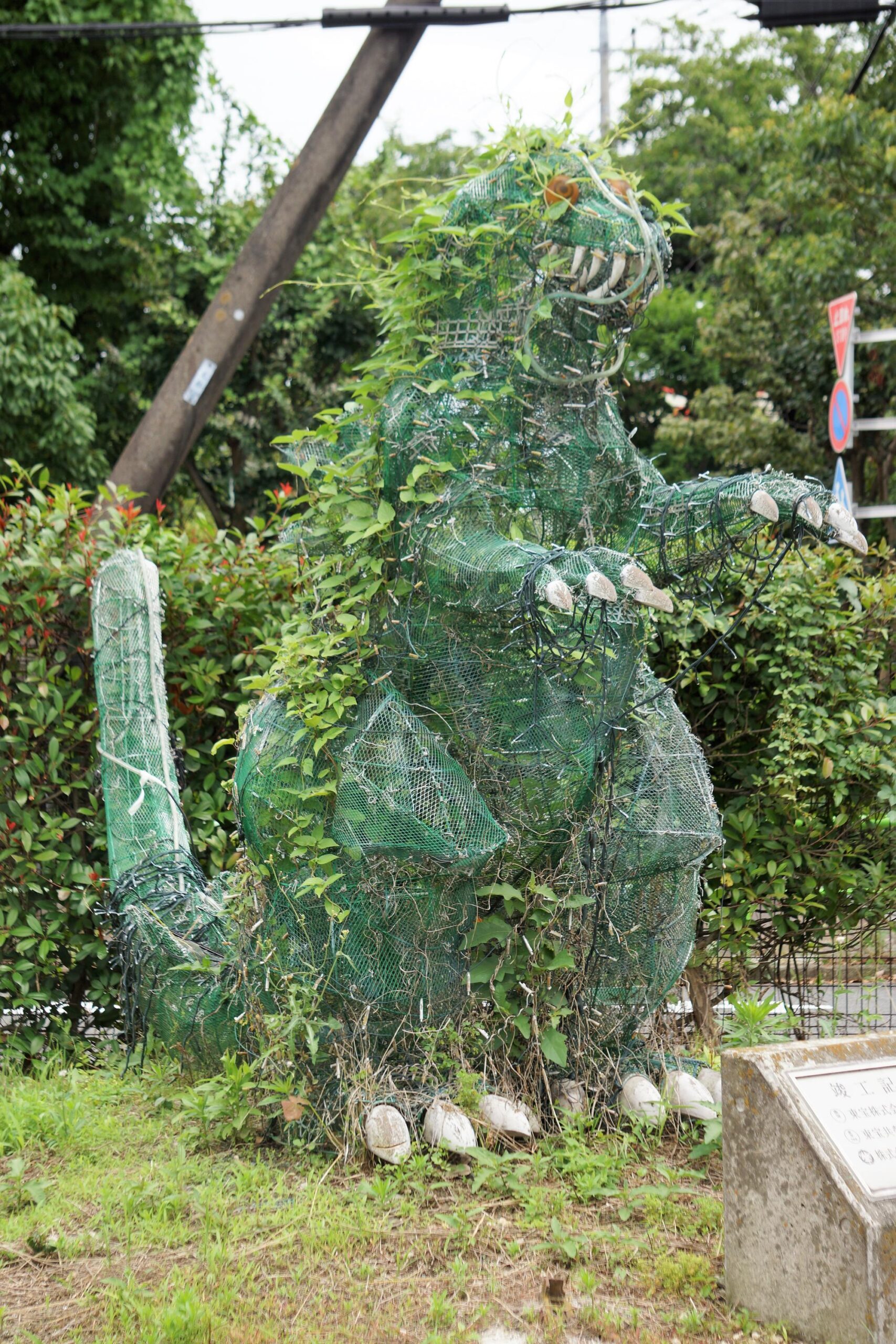
On what was something of a strange weekend, perhaps the weirdest moment came when I got to come face-to-face with a green, as in made of plants, Godzilla.

There’re plenty of Godzilla statues and effigies all over Tokyo, as I’ve reported before, and the rest of Japan, some life-sized, others tiny and plenty in-between and loving devoted to Japan’s most adored monster.

In western Tokyo, where I live, the most famous example is probably the Godzilla statue outside the TOHO CO., LTD. studios near Seijogakuen-mae, which is a bit of a trip for me further out in the boonies.

So, I was surprised to learn that there is actually a full authorized Godzilla not far from home, and it’s one that is a bit different to the others.

This Godzilla is a living sculpture, with the monster’s form made out of chicken wire and its scales and body comprised of the creeping plants that grow along the wire.

Of course, I got lost trying to find the Godzilla, despite having it mapped on my Wahoo Elemnt Bolt and having passed by Toho Chofu Sports Park, where it is listed as being located, daily for at least three years.

But it turns out I’d been given a bit of a bum steer, because it’s not located in the park at all, but in a nearby DIY center called DCM. A number of locals didn’t know of it, either, and were unable to give me directions. Finally, a gorgeous woman working at the sports park showed me the way.,

I couldn’t imagine why it was located in a hardware store, but that allowed me to surmise that probably had something to do with its somewhat disheveled appearance despite a formal headstone marking is September 1999 construction by TOHO CO., LTD., the Academy Award-winning movie studio that gave the world Godzilla, its subsidiary, Toho Kyoei Kigyo K.K., and general contractor, Mori-Gumi Co., Ltd.

It was only after I got home that I learned Toho Kyoei Kigyo operates the DCM chain and the penny finally dropped.

I have to admit I’ve seen more respectful treatment of TOHO’s top IP, but it was still interesting to find, which I did through the courtesy of a Facebook cycling group that I belong to but can’t credit because the post that inspired my trip has been deleted. And she looked great posed alongside the Death Machine.

Cop A Gander At These Rippers Too...

  • | |

    Oh, Maggie I Should Have Known! Bubble Era Tokyo’s Aussie Haven

    When I first got to Japan in the late 1980s, Australia was hot property–mainly in a literal sense for real estate investment, but also for honeymooners and koala fans. But finding anything “Australian” in Tokyo was bloody hard and homesickness particularly strong in those days, so I was deeply grateful for Maggie’s Revenge and the kangaroo awning that advertised the establishment. Maggie’s Revenge was an Aussie-themed bar in the Roppongi nightclub district of Tokyo, which was a bit of a drag for me to get to as I was living in the northern part of the capital at the time. Sometimes, you could buy a meat pie there, and always…

  • |

    Why Did Japan Fall In Love With The Frill-necked Lizard?

    なぜ日本はエリマキトカゲに夢中になったのか? Few Aussie animals have captured Japan’s imagination quite like the frill-necked lizard. For a brief moment in the 1980s, this remarkable reptile became one of Japan’s biggest stars. But why did one unusual Australian lizard become a household name nearly 7,000 kilometres from home? オージーの動物の中でも、1980年代に日本中を熱狂させた存在があります。それがエリマキトカゲです。なぜ、この少し変わったトカゲが遠く離れた日本で国民的人気を集めたのでしょうか。 An Unusual Aussie ちょっと変わったオージー Australia is famous for unusual wildlife. Kangaroos hop. Koalas sleep. But the frill-necked lizard does something completely different. When threatened, it spreads the large frill around its neck, opens its mouth wide and dashes away on its back legs. It’s one of nature’s most unforgettable displays. ちょっと変わったオージー オーストラリアには、不思議な動物がたくさんいます。 カンガルーは跳び、コアラは眠り続けます。 しかし、エリマキトカゲはまったく違います。 危険を感じると首の大きな襟を広げ、口を大きく開け、後ろ足だけで走ることがあります。 一度見たら忘れられない姿です。 The Commercial That Changed Everything すべてを変えたテレビCM In 1984,…

  • 32年間豪全体の注目を浴びた事件でディンゴが犯人と確定した

     過剰報道によってオーストラリア全体が32年間著しく注目を浴びたアザリア・チェンバレン失踪事件がようやく12日ダーウィンの検視法廷で9週間の赤ちゃんだったアザリアちゃんが1980年で野犬の一種であるディンゴにウルル周辺で連れ去られ、死亡したと結論付けた。  1980年当時、アザリア・チェンバレンの母であるリンディ・チェンバレン・クレートン氏は、「娘がディンゴに取られて」といい、赤ちゃんが失踪し以降死体も見つからなかった。当時、ディンゴが人間の赤ちゃんを食べることが信じられかったからチェンバレン・クレートン氏が殺したじゃないかとうわさされた。マスコミによりそのうわさが広がり、全国的の話題となった。ジョークなり、過剰報道となり、結局チェンバレン・クレートン氏が殺人罪に有罪判決となったが1987年に新しい証拠を見つかり釈放され、結局無罪となった。が、娘の死亡原因が「不明」であったため、長年ディンゴに取られたことの検証として死亡証明証の内容にそのことを示すように今回の裁判に乗り出した。  この事件の元にジョークや話題の種だけでなく、本・舞台・オペラ・レコードそしてメリル・ストリープがチェンバレン・クレートン氏役でハリウッド映画の題材まで課題となった。  オーストラリア文化を分かるためにこの事件のことを知ることが絶対必要なのだ! 「ディンゴがアザリアちゃんを連れ去り、殺害」 32年前の豪乳児失踪事件、「野犬が連れ去った」と結論 リンディ・チェンバレン Azaria Chamberlain Disappearance (English) 火曜日の判決報道 メリル・ストリープがリンディ・チェンバレン・クレートン氏役を演じた「Evil Angels」(1988年作)の予告編

  • | |

    Why Did a Japanese Potter Choose a Tiny Aussie Country Town?

    なぜ日本人陶芸家は小さなオージーの町を選んだのか? When Japanese ceramic artist Tatsuzo Shimaoka visited Australia, he wasn’t looking for fame. Instead, he helped inspire generations of Australian potters through workshops, demonstrations and friendships. His influence can still be found in studios across the country today. 日本を代表する陶芸家・島岡達三は、名声を求めてオーストラリアを訪れたわけではありません。彼は講習会や実演を通じて多くのオージー陶芸家に影響を与え、その足跡は今も各地の工房に残っています。 A Living National Treasure 人間国宝の陶芸家 Tatsuzo Shimaoka (1919–2007) was one of Japan’s most respected ceramic artists. In 1996, he was designated a Living National Treasure for his mastery of traditional pottery techniques. His work combined craftsmanship with humility—a combination that resonated strongly with Australian potters. 人間国宝の陶芸家 島岡達三(1919〜2007)は、日本を代表する陶芸家の一人です。 1996年には益子焼の技術で人間国宝に認定されました。 卓越した技術と謙虚な人柄は、多くのオージー陶芸家にも深い印象を与えました。 Sharing, Not Teaching 「教える」のではなく「分かち合う」 During his visits to Australia, Shimaoka gave demonstrations and workshops rather than formal lectures. He encouraged artists…

  • | |

    先住民がカカドゥ国立公園をさらに安全化

    大、大、大好きの編集者である都築響一のフェースブック・ページから得た情報だが、オーストラリア北部ノーザン・テリトリーにあり、世界遺産であるカカドゥ国立公園内クーンガラ地区がが世界遺産指定エリアに入り永遠に守れるようになる。  日本発信旅行ブログOnTimeによるとカカドゥは、ウランが大量にあり、オーストラリア経済に有力ある鉱業がどうしても掘り出したがっているが、先住民のジェフリー・リー氏がずーとクーンガラを守って行こうとした。  詳しくはOnTimeへ(日本語)

  • | |

    The Japan-Australia Link As A Fallen Star Became A Black Hole

    Japan has become pretty much synonymous with high quality construction, but that didn’t prove to be in what was supposed to be a star project in Melbourne but ended up being more of a black hole. The 120-meter-high Melbourne Star Ferris wheel was supposed to be a boon for tourism in Australia’s largest city, as well as a strong leap forward for Sanoyas, an Osaka-based shipbuilding company looking to expand into the amusement park business. The Melbourne Star was plagued from the outset. It was supposed to open in 2006, but didn’t start taking customers until two years later. It ran for just 40 days when it was shut down…