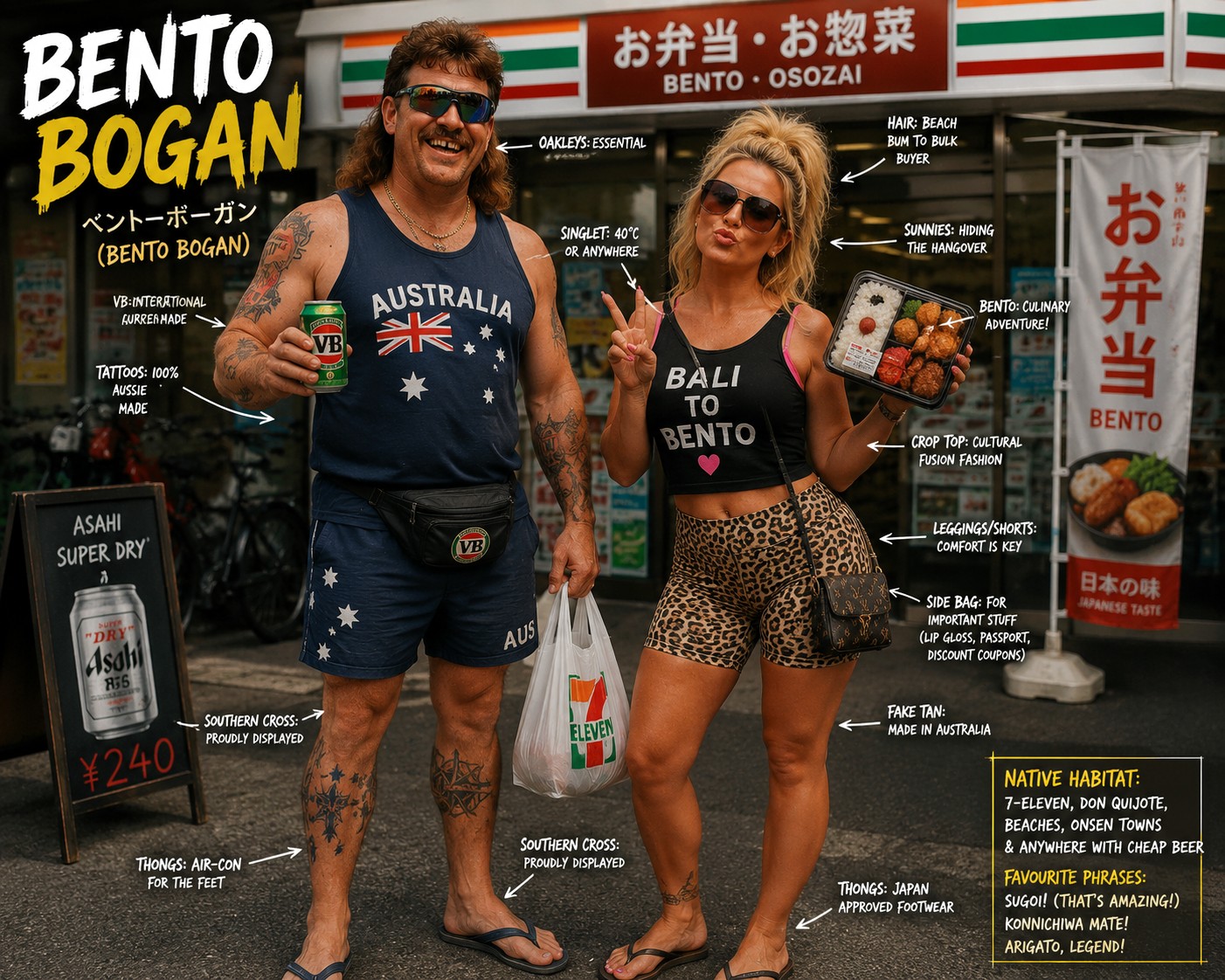
The “Bento Bogan”:日本に出現した新種のオージー

日本のインバウンドブームが続く中で、 オーストラリア人観光客の“新しいステレオタイプ”が誕生している。オーストラリアの一部では、これを冗談めかして “日本のボーガン化(boganisation of Japan)” と呼び始めている。

背景は本物だ。

  • パンデミック後の日本人気爆発
  • オーストラリアからの近さ
  • 円安という追い風
  • 日本の圧倒的な観光魅力

これらが重なり、 オージーの日本旅行が過去最高レベルに増加。2025年の報告では、 2024年1〜9月のオーストラリア人訪日客は 637,300人。 これは2019年の記録的期間と比べて 42%増。

そんな中で、オージーの間で冗談として語られ始めた新キャラがある。

The Bento Bogan(ベントー・ボーガン)とは?

これは、 “バリでのオージー文化パッケージ”をそのまま日本に持ち込んだ人 を指す軽いジョーク。その文化パッケージとは:

  • ビール
  • 大声
  • ビーチサンダル(thongs)
  • タトゥー
  • フッティ愛
  • 過剰な自信
  • “She’ll be right”(なんとかなる精神)
  • そして、ちょっと微妙な公共マナー

これらを全部抱えたまま、 コンビニの唐揚げ棒と駅弁を手に日本を闊歩するオージー像。もちろん、これはあくまで ユーモアとしてのステレオタイプ。でも、 日本の礼儀正しさとオージーの“気楽さ”がぶつかると、 こういう文化的ミックスが自然に生まれるのが面白い。

なぜ“Bento Bogan”が生まれたのか?

理由はシンプル。

  • 日本がオージーにとって“安くて近くて最高”になった
  • 日本の街が安全で歩きやすい
  • オージーの旅行文化がカジュアルで陽気
  • SNSでの日本旅行自慢が爆増
  • 日本のコンビニ飯がオージーにとって神レベル

これらが重なり、 “日本で自由に楽しむオージー”という新しい文化像が形成された。それが冗談として Bento Bogan と呼ばれているわけだ。

文化的には何が面白い?

Bento Bogan は、 オーストラリアのボーガン文化が海外でどう変形するか を観察できる絶好のケース。

  • ボーガンの陽気さ
  • ボーガンの気取らなさ
  • ボーガンの“なんとかなる”精神
  • ボーガンのファッション
  • ボーガンの旅行スタイル

これらが日本という全く異なる文化環境で 新しいキャラクターとして再構成される。文化の輸出と変形の好例。

Cop A Gander At These Rippers Too...

  • |

    Cheap As Chips Akiya For Aussies: One-Stop Bogan Basement Buys

    Cheap Houses in Japan for Aussies Japan’s market for akiya, literally “empty homes,” continues to offer astonishing bargains — from ¥0 giveaways to charming kominka under ¥1 million. And with the yen being weaker against the Aussie dollar than it has been for decades, there’s no better time for those Down Under to get on top of the akiya trend. Market Snapshot Japan’s depopulation continues to accelerate, especially in rural prefectures. Municipalities are increasingly motivated to offload vacant homes, and several regions have expanded subsidies for renovation, relocation, or child‑raising. With the yen at an historically low level, even renovated homes are now comparatively affordable. Top Akiya Listing Sites (With…

  • Bogan Culture: A Cultural Report

    Executive summary The first thing to understand is that “bogan” is not really the name of a single, coherent social group. It is a remarkably flexible Australian cultural label. At various times it has meant: That last transformation is probably the most interesting. “Bogan” began largely as an insult but has been partly reclaimed as a badge of authenticity, national identity and resistance to cultural snobbery. Linguist Roslyn Rowen describes it as a distinctive Australian cultural keyword whose negative meaning can be transformed into positive self-identification and Australian nationalism. And there is a delicious paradox at the heart of it: The bogan has become fashionable precisely because the bogan is…

  • |

    Back To The Basics To Take The Strain Out Of Strine

    Kangaeroo.com originally started as a bit of a joke site focused on Strine–the word to describe Australian English that is a play on the word “Australian” as pronounced in a broad Aussie accent. In the earliest years of the site, language played a central role in content. I created categories like やばいリンガル, which was loosely for words that were a little bit on the naughtier side, or yabai, in both English and Japanese. Then we had 豪cabulary that honed in on individual words that are distinctly Australian with the category being a portmanteau of go (豪), the kanji abbreviation used in Japanese for the now virtually archaic name for Australia…

  • |

    豪キャブラリ:flannie

    In Strine, a flannie is a shirt made out of a wool-like material called flannelette. The flannie, sometimes also called a flanno, is an iconic item of clothing in Australia, often viewed as part of the bogan uniform. ストライン(オージー英語)では、「flannie」とは、フランネルというウールのような素材で作られたシャツのことを指します。「flannie」は「flanno」とも呼ばれることがあり、オーストラリアを代表する衣類の一つであり、しばしば「bogan」の定番スタイルの一部と見なされています。 The flannel can also be used to refer to a wash cloth. Flannelは、雑巾の意味もある。

  • The Great Bogan Aesthetic

    The visual language is almost a complete design system. Hair The mullet is probably the supreme bogan symbol. Business at the front. Party at the back. And, increasingly, deliberate cultural signalling. The mullet has moved far beyond its original association with rough Australian masculinity and has become a self-conscious Australian cultural icon. Mullet competitions have become an actual spectacle, with categories such as “extreme”, “grubby”, “everyday” and “ranga”. There are even children’s mullet competitions in Australia in 2026. That is an extraordinary example of a hairstyle moving from social stigma → joke → nostalgia → fashion → identity. Clothing The classic wardrobe includes: But again, the interesting thing is that…

  • |

    やばいリンガル:Westie

    A westie, at least the version in Strine, is a bogan from the western suburbs of Sydney. A bogan, of course, is a person whose speech, mannerisms, appearance, clothing, behaviour, or attitudes are considered unrefined or unsophisticated. Bogans are often symbolized by a flannie and a mullet. 「Westy」とは、少なくともストライン(オーストラリア英語)における定義では、シドニー西部の郊外出身の「bogan」を指す。言うまでもなく、「bogan」とは、話し方、仕草、外見、服装、振る舞い、あるいは態度が、洗練されていない、あるいは野暮ったいと見なされる人のことだ。ボーガンは、しばしばフランネルシャツとマレットヘアで象徴される。 There are numerous types of bogans, including the snow bogans who swarm to Japan on bogan missiles. And New Zealand English, which is like an emerging version of Strine, also has westies, these being from the western suburbs of Auckland. The Japanese equivalent to the bogan or westie is the yankii. 「Bogan missile」に乗って来日に蔓延している「snow bogans」を含めて、ボーガンには様々なタイプが存在する。また、ストラインの派生版とも言えるニュージーランド英語にも「westy」という言葉があり、こちらはオークランドの西郊外出身者を指す。ボーガンやウェスティに相当する日本の言葉は「ヤンキー」である。