How Did A 19th Century Kangaroo Spark Japan-Australia Ties That Now Seem A Perfect Match?
カンガルーが火をつけた日豪交流 ― まさに“マッチ”した関係の始まり?

Long before Australia became one of Japan’s closest partners, Japanese manufacturers had been using kangaroos to promote their products.
The earliest documented reference to the commercial use of a kangaroo in Japan came from 1884, when a misemono traveling curiosity show advertised that it would feature a fukuro nezumi, literally a pouch mouse, at the Tenmangu Shrine grounds in Osaka.
オーストラリアが日本の最も親しいパートナーの一つとなるはるか以前、日本のメーカーはすでにカンガルーを商品の宣伝に活用していました。
現在確認されている日本におけるカンガルーの最初期の商業利用は、1884年に大阪・天満宮境内で開かれた見世物興行の広告です。そこには、カンガルーが「袋鼠(ふくろねずみ)」として紹介されていました。
A Kangaroo on a Matchbox
マッチラベルに描かれたカンガルー
Japan first enacted a trademark registration system in June 1885, and Kobe-based match manufacturer Seisuisha registered its first trademark on Oct. 11 of that year. It was a matchbox featuring a lion. The lion was part of a series of matchbox images featuring animals, one of which would be a kangaroo. By the end of the 19th century, Japanese manufacturers weaponized the kangaroo image to tap into international markets, namely the then federalizing Australian colonies.
マッチラベルに描かれたカンガルー
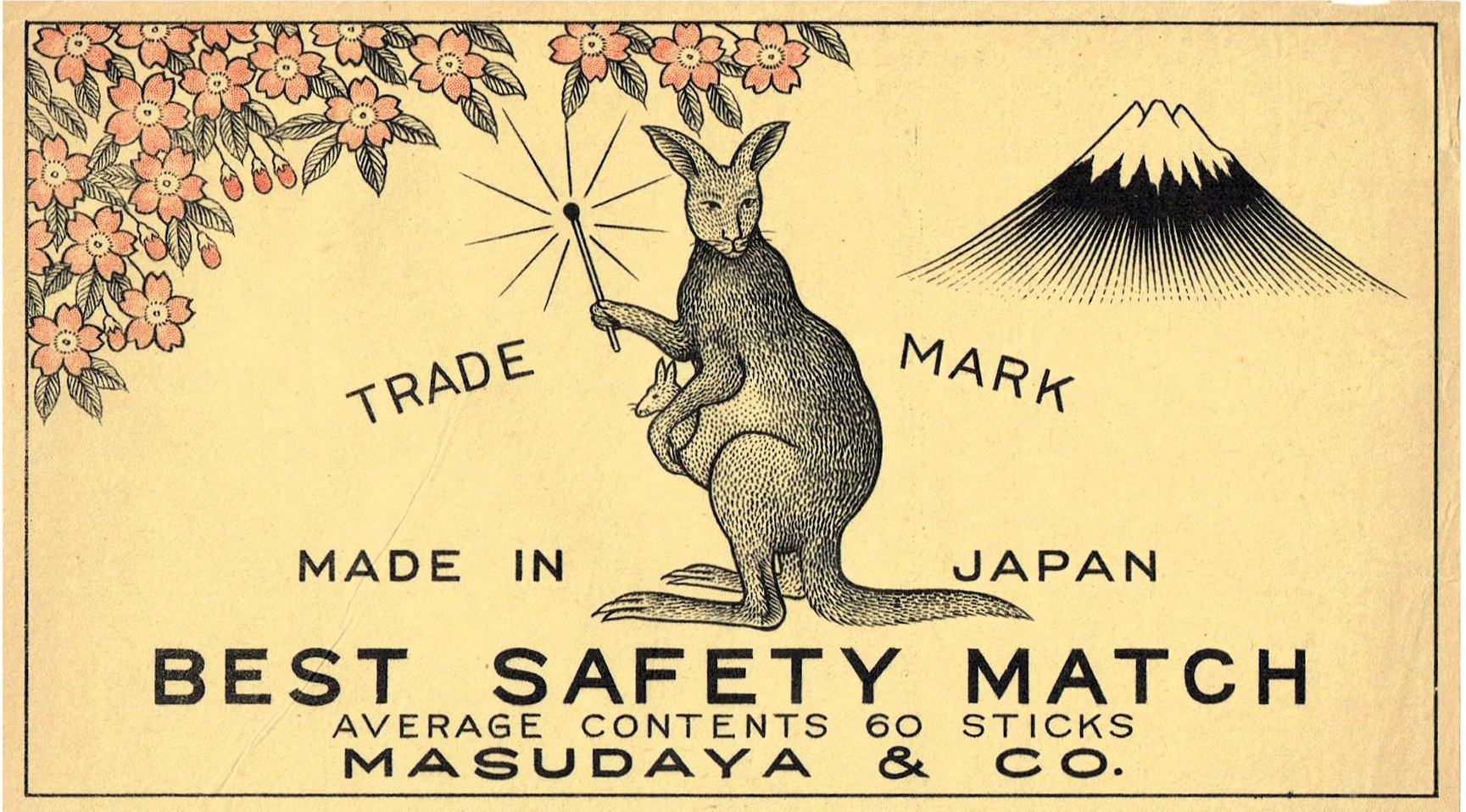
現存する日本のマッチラベルの中には、カンガルーを主なデザインとして描いたものがあります。
日本で商標登録制度が始まったのは1885(明治18)年6月のことです。同年10月11日、神戸の燐寸(マッチ)メーカー「清水社(Seisuisha)」は、ライオンを描いた商標を登録しました。
このライオンは、さまざまな動物を題材にしたマッチラベル・シリーズの一つで、その後にはカンガルーを描いたデザインも登場します。
19世紀末までには、日本のマッチメーカーはカンガルーをオーストラリアの象徴として積極的に採用し、連邦成立前のオーストラリア植民地市場への輸出を意識した商品展開を行っていました。

Australia’s Most Recognisable Animal
オーストラリアを象徴する動物
By the late nineteenth century, the kangaroo had become widely recognised overseas as a symbol of Australia.
For Japanese manufacturers, it was an image that immediately conveyed an Australian connection, even to customers who had never visited the country.
オーストラリアを象徴する動物
19世紀後半には、カンガルーは海外でもオーストラリアを象徴する動物として広く知られるようになっていました。
日本の製造業者にとっても、カンガルーは「オーストラリアらしさ」をひと目で伝えるデザインだったのでしょう。

A Small Label with a Big Story
By the late 19th century, Japan had emerged as the world’s leading exporter of matches, and between 1890 and 1910, Japanese companies not only imitated Western matchbox designs but also infused them with traditional Japanese motifs, creating a unique blend of East and West.
This period, spanning the Meiji era, was when matchbox labels really came into their own as miniature canvases for graphic design. The labels had serious commercial weight since matches were being shipped to markets across the United States, Australia, England, France, and India.
Although only a small piece of printed paper, the label hints at an early commercial awareness of Australia in Japan. It reminds us that trade, design and popular culture often build international familiarity long before formal diplomacy captures public attention. This humble matchbox is an important milestone in the history of Australia–Japan commercial relations.
小さなラベルが語る大きな物語
19世紀後半、日本は世界有数のマッチ輸出国へと成長しました。1890年代から1910年代にかけて、日本のメーカーは欧米のデザインを取り入れながら、日本独自の美意識や意匠を融合させたマッチラベルを数多く生み出しました。
明治時代のマッチラベルは、小さな広告であると同時に、優れたグラフィックデザイン作品でもありました。日本製のマッチは、アメリカ、オーストラリア、イギリス、フランス、インドなど世界各地へ輸出され、そのラベルは日本の技術力とデザイン性を伝える「小さな名刺」の役割を果たしていました。
一枚の小さな紙片に過ぎませんが、このカンガルーのラベルは、日本におけるオーストラリアへの関心が商業の世界にも広がっていたことを物語っています。
貿易やデザイン、そして日用品は、外交よりも早く人々の心をつなぐことがあります。
このマッチラベルは、日豪商業交流の黎明期を今に伝える貴重な歴史資料なのです。
Did You Know?
Japanese matchbox labels are now valued by historians because they preserve thousands of examples of commercial art from the late nineteenth and early twentieth centuries. They provide a unique record of how manufacturers promoted products and represented foreign countries.
豆知識
日本のマッチラベルは、19世紀後半から20世紀初頭の商業デザインを伝える貴重な資料として研究されています。当時の広告や海外イメージを知る手がかりにもなっています。