How Did A 19th Century Kangaroo Spark Japan-Australia Ties That Now Seem A Perfect Match?

カンガルーが火をつけた日豪交流 ― まさに“マッチ”した関係の始まり?

Probably the first trademarked Japanese product to feature a kangaroo logo, dating back to the late 19th century

Long before Australia became one of Japan’s closest partners, Japanese manufacturers had been using kangaroos to promote their products.

The earliest documented reference to the commercial use of a kangaroo in Japan came from 1884, when a misemono traveling curiosity show advertised that it would feature a fukuro nezumi, literally a pouch mouse, at the Tenmangu Shrine grounds in Osaka.

オーストラリアが日本の最も親しいパートナーの一つとなるはるか以前、日本のメーカーはすでにカンガルーを商品の宣伝に活用していました。

現在確認されている日本におけるカンガルーの最初期の商業利用は、1884年に大阪・天満宮境内で開かれた見世物興行の広告です。そこには、カンガルーが「袋鼠(ふくろねずみ)」として紹介されていました。


A Kangaroo on a Matchbox

マッチラベルに描かれたカンガルー

Japan first enacted a trademark registration system in June 1885, and Kobe-based match manufacturer Seisuisha registered its first trademark on Oct. 11 of that year. It was a matchbox featuring a lion. The lion was part of a series of matchbox images featuring animals, one of which would be a kangaroo. By the end of the 19th century, Japanese manufacturers weaponized the kangaroo image to tap into international markets, namely the then federalizing Australian colonies.

マッチラベルに描かれたカンガルー

現存する日本のマッチラベルの中には、カンガルーを主なデザインとして描いたものがあります。

日本で商標登録制度が始まったのは1885(明治18)年6月のことです。同年10月11日、神戸の燐寸(マッチ)メーカー「清水社(Seisuisha)」は、ライオンを描いた商標を登録しました。

このライオンは、さまざまな動物を題材にしたマッチラベル・シリーズの一つで、その後にはカンガルーを描いたデザインも登場します。

19世紀末までには、日本のマッチメーカーはカンガルーをオーストラリアの象徴として積極的に採用し、連邦成立前のオーストラリア植民地市場への輸出を意識した商品展開を行っていました。


Another early kangaroo matchbox from Japan

Australia’s Most Recognisable Animal

オーストラリアを象徴する動物

By the late nineteenth century, the kangaroo had become widely recognised overseas as a symbol of Australia.

For Japanese manufacturers, it was an image that immediately conveyed an Australian connection, even to customers who had never visited the country.

オーストラリアを象徴する動物

19世紀後半には、カンガルーは海外でもオーストラリアを象徴する動物として広く知られるようになっていました。

日本の製造業者にとっても、カンガルーは「オーストラリアらしさ」をひと目で伝えるデザインだったのでしょう。

Japanese match manufacturers got the images a lot closer than many other places did

A Small Label with a Big Story

By the late 19th century, Japan had emerged as the world’s leading exporter of matches, and between 1890 and 1910, Japanese companies not only imitated Western matchbox designs but also infused them with traditional Japanese motifs, creating a unique blend of East and West.

This period, spanning the Meiji era, was when matchbox labels really came into their own as miniature canvases for graphic design. The labels had serious commercial weight since matches were being shipped to markets across the United States, Australia, England, France, and India.

Although only a small piece of printed paper, the label hints at an early commercial awareness of Australia in Japan. It reminds us that trade, design and popular culture often build international familiarity long before formal diplomacy captures public attention. This humble matchbox is an important milestone in the history of Australia–Japan commercial relations.

小さなラベルが語る大きな物語

19世紀後半、日本は世界有数のマッチ輸出国へと成長しました。1890年代から1910年代にかけて、日本のメーカーは欧米のデザインを取り入れながら、日本独自の美意識や意匠を融合させたマッチラベルを数多く生み出しました。

明治時代のマッチラベルは、小さな広告であると同時に、優れたグラフィックデザイン作品でもありました。日本製のマッチは、アメリカ、オーストラリア、イギリス、フランス、インドなど世界各地へ輸出され、そのラベルは日本の技術力とデザイン性を伝える「小さな名刺」の役割を果たしていました。

一枚の小さな紙片に過ぎませんが、このカンガルーのラベルは、日本におけるオーストラリアへの関心が商業の世界にも広がっていたことを物語っています。

貿易やデザイン、そして日用品は、外交よりも早く人々の心をつなぐことがあります。

このマッチラベルは、日豪商業交流の黎明期を今に伝える貴重な歴史資料なのです。
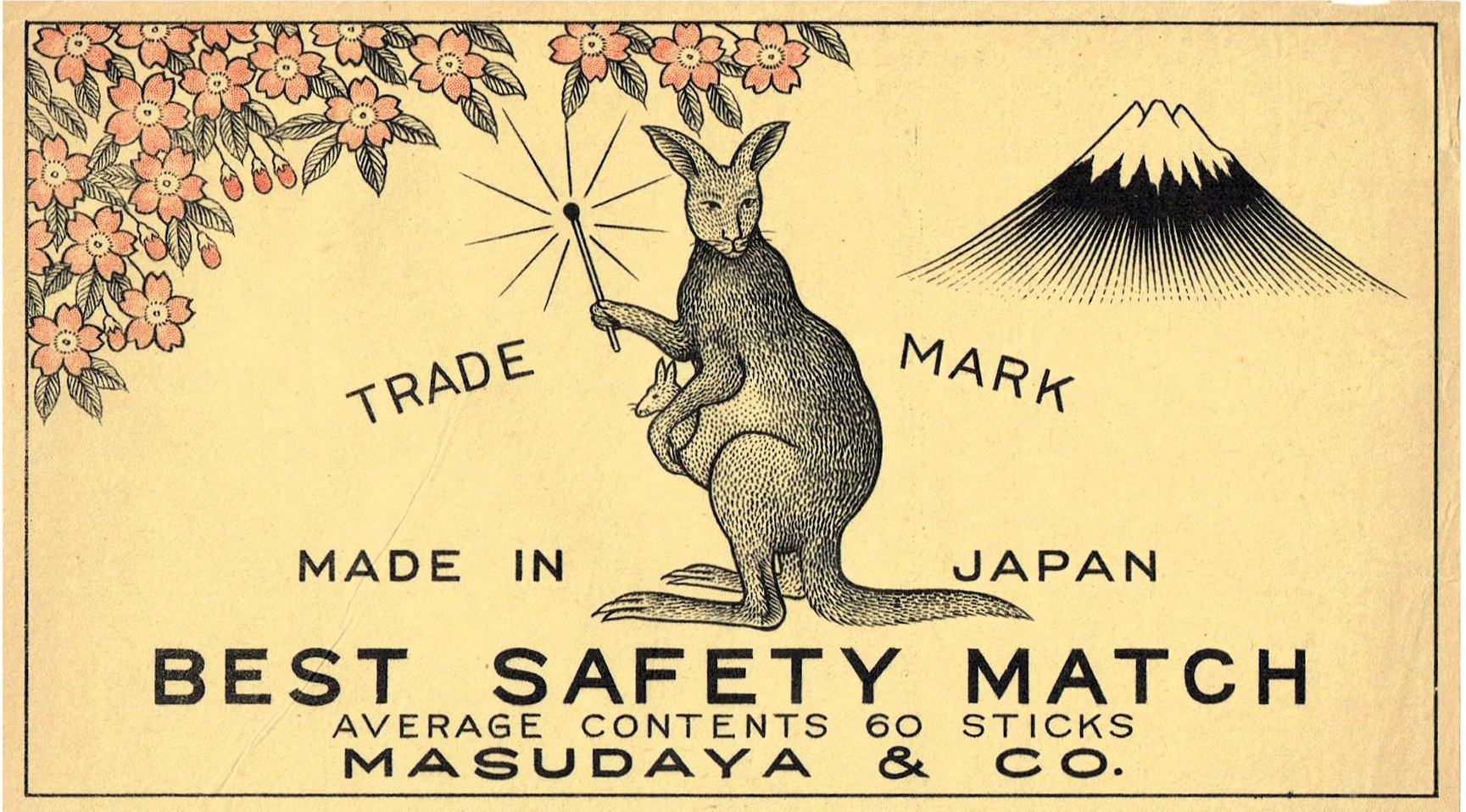

Kangaroos remained a matchbox favorite for Japanese manufacturers into the 1930s and beyond

Did You Know?

Japanese matchbox labels are now valued by historians because they preserve thousands of examples of commercial art from the late nineteenth and early twentieth centuries. They provide a unique record of how manufacturers promoted products and represented foreign countries.

豆知識

日本のマッチラベルは、19世紀後半から20世紀初頭の商業デザインを伝える貴重な資料として研究されています。当時の広告や海外イメージを知る手がかりにもなっています。


Sources

Cop A Gander At These Rippers Too...

  • | |

    Pigging Out On Pie Face And ‘Ello Elton

    It was a bit of a landmark month as Aussie meet pies went on sale in central Tokyo as Pie Face opened a store in Shibuya, while down the road in Yokohama I got an unexpected chance to see Elton John live. The pies were tasty, but a bit pricey, yet my workmates humored me with a visit there to dine together as the restaurant is within short walking distance of our office. Elton, meanwhile, wasn’t someone I was overly keen on seeing, but I was pleased to get the chance. He was basically going through the motions, though, and didn’t really put on a dazzling display. Having received a…

  • | |

    ハーバーブリッジ80周年

    シドニー、いや、オーストラリア全体の象徴ひとつであるは、今週開通80周年を迎えた。  ハーバー・ブリッジの建設は約10年かかって、開会式ではニューサウスウェルズ州知事ジャック・ラングの先に右翼団体のメンバーがリボンを来て馬で逃げたという事件から歴史がちょっと暗いスタートで始まったが、以降ハーバー・ブリッジがオーストラリアの誇りとなり、今でもシドニーの人々にとって大きな存在感を持つ。  建設当時から1967年までシドニーも最も高い建物であった上に今でも同市の最長建物である。  交通・環状道路などだけじゃなく、観光スポットとして有名であり、2000年のシドニー五輪の顔をはじめ、ハーバーブリッジ・クライム(よじ登る)及花火の打ち上げなどでも世界中に幅広く評価されている。 Sydney Harbor Bridge (English) 豪キャブラリー:Coathanger Happy Birthday Harbour Bridge

  • |

    Australian Football’s Tokyo Area ‘Samurai’ Off to the World Cup

    Australia rarely makes the news in Japan, so it’s interesting to see it on the front page of the Asahi newspaper June 4 evening edition. The story is about Japan’s Aussie Rules team, the Samurais, who’ll be battling it out in the International Cup starting from June 8. Japan has a really small, but thriving, Australian Rules competition, with two leagues (including several all-Japanese teams), the Eastern League, centering on Tokyo and surrounding areas, and the Western League, comprising Osaka and Nagoya. Here’s an excerpt from the Asahi report: サッカー・ワールドカップ(W杯)大会が迫るなか、「世界で最も激しい」というフットボールの世界大会も8月に開かれる。それってラグビー? いえいえ、オーストラリアンフットボール。豪州では国技と言われる大人気のプロスポーツだ。5大会連続で出場する日本代表も、追い込みに入っている。 A translation: Just as the soccer World Cup is about to hit us, another football world championship — this one…

  • | |

    Strine-speaking, Sydney-born star made Japan’s queen of natto fermented beans

    Strine-speaking Shiori Kutsuna has been declared the 2012 Natto Queen, an award handed out to celebrities who promote fermented soybeans, or natto, as they’re known in Japanese. Kutsuna, a 19-year-old Sydney-born actress, was presented with her award at a ceremony in Tokyo earlier this week. Natto are a popular dish, particularly in eastern Japan, and are highly valued for their nutritional content and health benefits. Less widely praised are the gooey, sticky texture of the fermented beans. Kutsuna was born in Sydney and spent her formative years in Australia’s biggest city, learning how to speak fluent Strine. She is a dual Australian-Japanese citizen. As Japan’s Natto Queen, an award bestowed…

  • |

    Australian Ambassador Urges Japanese TPP Involvement

    Australian Ambassador to Japan Bruce Miller has implored Japan to actively engage in negotiations for the Trans-Pacific Partnership (TPP). Miller, during an interview with a Japanese newspaper during the week, called the relationship between the two countries a “win-win” one, then went on to urge Japan to grow, saying that Asia could not grow without Japan. Miller spoke to the newspaper about the recently released white paper, “Australia in the Asian Century,” in which Japan was named as an important partner for Australia. Miller said that Australia can contribute to Asia in many ways, helping with economic growth through the stable supply of natural resources and contributing to regional security….

  • |

    日豪関係の論文で50万円懸賞

     日豪経済委員会では、設立50周年を記念して、日豪関係をテーマにした懸賞論文の募集をしている。   日豪両国関係についての意識を深める機会として、広く学生・社会人の皆様の積極的な応募を呼びかけている。  日豪経済委員会会長賞は、賞金50万円であり、副賞が日本・シドニー往復航空券+3泊宿泊代。また、審査委員長賞は、賞金20万円で副賞が日本・シドニー往復航空券+3泊宿泊代。  日本語で1万字・英語4,000ワードまでの論文を募集中。締切は5月31日。  詳細は日豪経済委員会50周年懸賞論文のお知らせまで。