Unknown Nichigo

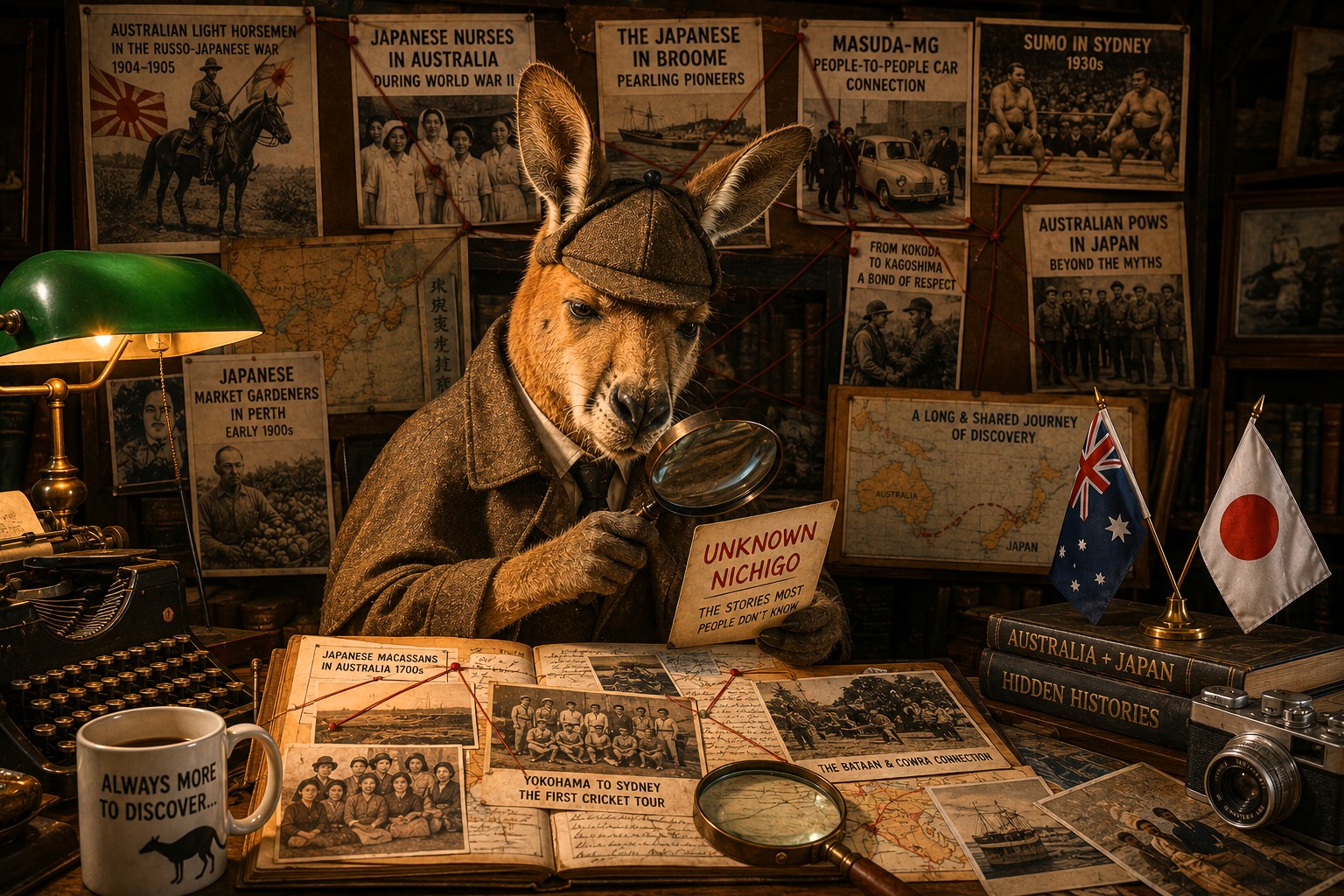
Learn more about the lesser-known aspects of the Japan-Australia relationship.
日本とオーストラリアの関係に隠れた、あまり知られていない側面についてもっと知ってみよう

  • |

    Bigger Than The Beatles! ’60s Strayan Schoolkids Swoon At Shintaro The Samurai

    Possibly my first connection with Japan was waking at an ungodly hour (lifelong habit) and turning on the telly to watch Shintaro the samurai and his sidekick, Tombei the Mist, take on the evil Koga ninja and other assorted nasties threatening the Shogunate. I was watching The Samurai, a program where Shintaro, played by Koichi Ose, possibly did more than anything else to restore friendly postwar relations between Australia and Japan. The Samurai was the first Japanese TV to screen in Australia in late 1965, and when Ose toured Down Under the following year, thousands of children swarmed Melbourne and Sydney airports to catch a glimpse of their hero, their…

  • Whatever Happened To Japan’s Emu-chan?

    Emus take pride of place in the Australian Coat of Arms alongside the kangaroos upon which this site has a focus. And Emu-chan played a crucial role in raising spirits in Japan during the darkest days of the Covid-19 pandemic before suddenly and mysteriously disappearing. Sabaku, the pseudonym used by a Japanese woman working in central Tokyo and “living in the mountains about an hour’s drive from the city” according to Bunshun Online, caused a national sensation with her YouTube channel Live Together With Emu up until late 2023. Videos told the tale of Sabaku’s life with Emu-chan, which she had raised from a hatchling, delighting people with footage of…

  • | |

    The Japan-Australia Link To The Great Train Robbery

    Ronnie Biggs and the Great Train Robbery were pretty well-known among my generation of Australians growing up, and recognition of the famous long-term fugitive was enough in Japan for his 2014 death to be widely reported. What is less established, however, is that both Japan and Australia have a much closer connection to the crook than many in either country know. Biggs was one of a gang of about 16 people who carried out the Great Train Robbery in 1963, making off with 2.61 million pounds (worth about 12.16 billion yen today). Biggs used his share of the haul to pay for almost 40 years on the run, most famously…

  • |

    Japan’s Fans Still Go Mad For Australia’s Most Successful Film Franchise

    One of the most outstanding characteristics I have found of many Japanese people in almost four decades of living here is that it is highly common for fun to be taken very seriously, indeed. One area where I have seen that trait on display comes with the franchise related to Mad Max, whose five movies dating from 1979’s Mad Max to Furiosia: A Mad Max Saga in 2024 make it the most successful Australian cinematic series in history. In fact, had it not been for avid fans in Japan, the franchise would probably not have continued past the first entry, but Mad Max has also given back to Japan, inspiring…

  • | |

    Oh, Maggie I Should Have Known! Bubble Era Tokyo’s Aussie Haven

    When I first got to Japan in the late 1980s, Australia was hot property–mainly in a literal sense for real estate investment, but also for honeymooners and koala fans. But finding anything “Australian” in Tokyo was bloody hard and homesickness particularly strong in those days, so I was deeply grateful for Maggie’s Revenge and the kangaroo awning that advertised the establishment. Maggie’s Revenge was an Aussie-themed bar in the Roppongi nightclub district of Tokyo, which was a bit of a drag for me to get to as I was living in the northern part of the capital at the time. Sometimes, you could buy a meat pie there, and always…

  • | |

    A Symbol Of Japan That Fits Australia Like A Shoe

    Given the powerful pull of the surf culture in Australia, a link with Katsushika Hokusai‘s The Great Wave Off Kanagawa that immediately conveys an image of Japan was almost inevitable, but also symbolizes the strong ties between the two countries almost made for each other. Countless Australian companies, organizations, entrepreneurs, artists and others utilize or have utilized directly or derivatively the iconic Japanese work forming one of Hokusai’s Thirty-six Views of Mount Fuji. Even though the Great Wave is an instantly recognizable image that embodies the essence of Japanese spirit, particularly with the inclusion of Mount Fuji, Australia has long recognized the work as a shared connection between the countries….

  • | |

    Jumping At Chances Through A Yen For Kangaroos

    Vacel Inc. is a Tokyo company with a yen for kangaroos, literally and figuratively speaking, as well as a track record with marsupials that leaps from sporting fields to dining tables. The trading and manufacturing company specializing in kangaroo derived products started off in April 1980 as a specialist in kangaroo leather products mostly for soccer boots and then expanded over the subsequent decades to encompass all sorts of businesses including marsupial meat. Vacel imports, manufactures and sells kangaroo leather, develops FabRoo 0.3 mm ultra-thin leather, operates the RooMeat brand for kangaroo meat for human and pet consumption, and provides market-entry and liaison services for overseas companies in Japan. Vacel…

  • | |

    Melburnian’s Kagawa Kangaroo Business Is Bounding

    Melburnian Suliana Tesi Nakamura looks to be doing very nicely operating Kangaroo K.K., an English conversation school and real estate business located in Takamatsu, Kagawa Prefecture, where she has lived since 2011. Aussie Nakamura’s choice of the kangaroo for her company and logo is pretty bloody obvious, and a logical choice for the woman who moved to Japan in 2005 and taught English in Tokyo before moving to her current location. Nakamura worked in real estate Down Under and is using her multicultural background to leverage her multifaceted business now. The appearance of any company, organization, or individual on Kangaeroo.com does not constitute an endorsement, approval, or criticism of that…

  • | |

    Nissan’s Fine Fragrance From Perfumed Kangaroos

    Automaker Nissan Motor Co. has long used kangaroos in its advertising, particularly in the early 2010s and notably when enlisting the aid of technopop girl group Perfume, which was then at the peak of its popularity. Nissan stylized Perfume’s three members–Kashiyuka, A-chan and Nocchi–as pink kangaroos to promote its Serena, Note and Cube models. Perfume used the opportunity for a cross-promotion of their then-newly released single, Voice, which would go on to reach No. 2 on the Oricon national charts. The campaign aimed to get the attention of a young, pop-loving audience who enjoyed animated characters and prompt them into visiting a Nissan dealership. The ad ran from July 14,…

  • | |

    Japan’s Mobs Of Macropod Motifs Missing Marsupials In Masterpieces

    Something strikes me about kangaroos in Japan, where companies like Seino and Nikko Kanko have made the marsupials highly visible. Kangaroos are possibly even higher profile than their native Australia, where Qantas uses the national symbol in its logo, but the macropod is a somewhat uncommon sight elsewhere in the corporate sector. I wouldn’t go so far as to say kangaroos are a ubiquitous presence in the Japanese retail or corporate sector, but it would be no exaggeration to claim they are a daily presence. Far more so, actually, than they are in Australia. That got me to thinking about the presence of kangaroos in the Japanese art world, which…