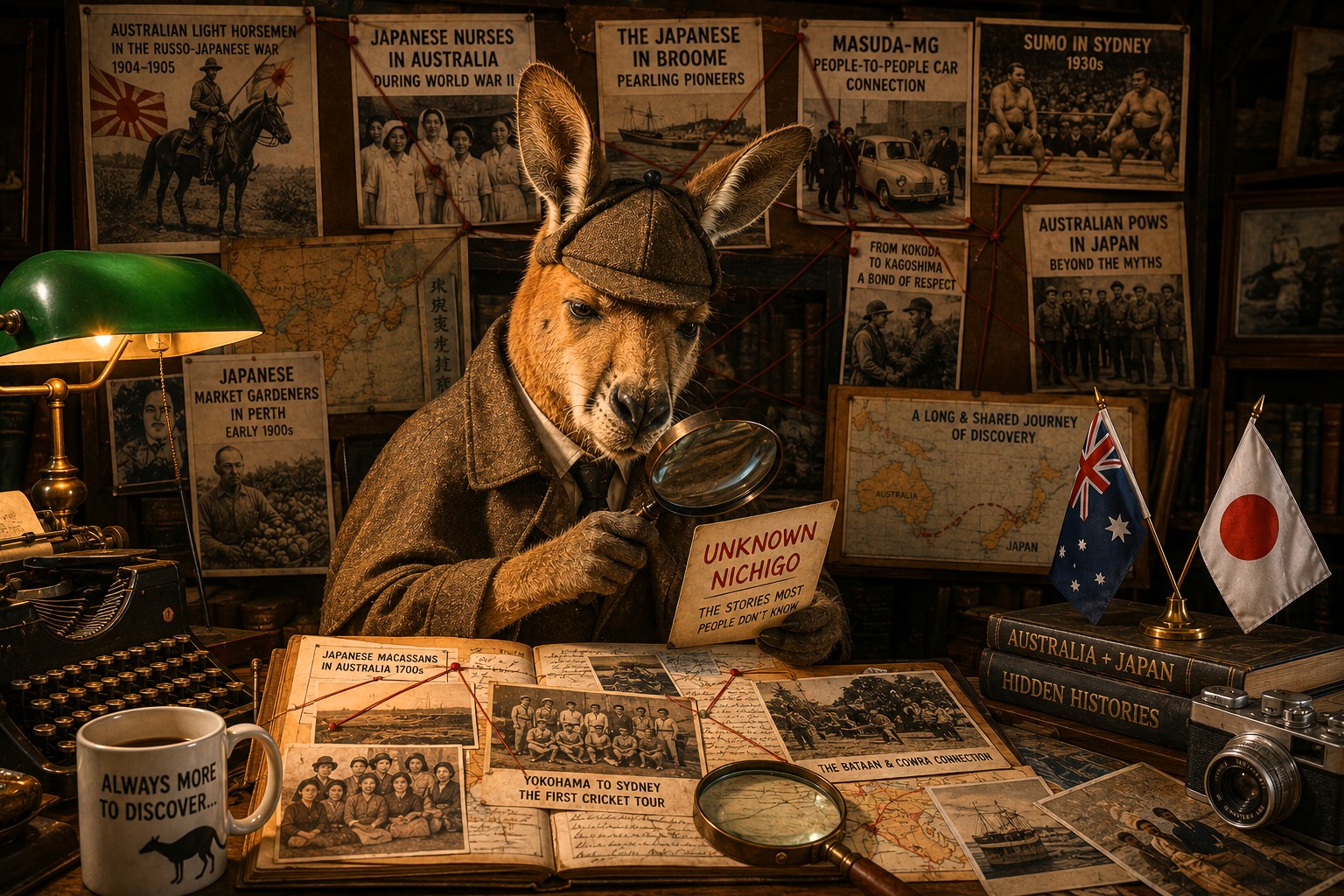
Unknown Nichigo

Learn more about the lesser-known aspects of the Japan-Australia relationship.
日本とオーストラリアの関係に隠れた、あまり知られていない側面についてもっと知ってみよう

  • Anti-Asian ‘Rage Ranga’ Pauline Hanson’s Soft Spot For Japan

    Populist politicians are on the ascendency across the globe. Japan is heading to the polls with Prime Minister Sanae Takaichi, who can probably be called a populist, tapping into strong anti-foreigner sentiment to give her Liberal Democratic Party its traditional grip on power. Joining demagogues like Trump, Farage, Le Pen, Wilders and Milei is Australia’s own “rage ranga” Pauline Hanson, whose political fortunes have taken an astonishing turn. Before going forward, a bit of disclosure: I despise the right-wing form of demagoguery spreading around the world, but lean toward populism on the opposite side of the political spectrum. I’m an angry, fearful old man. That makes me a prime populist…

  • |

    Why Does Australia Have So Many Japanese War Memorials?

    なぜオーストラリアには日本人戦没者慰霊碑がこんなに多いのか? Most Australians know about the fierce fighting against Japan during the Second World War. Few realise that Australia is also home to dozens of memorials dedicated to Japanese people. How can a country that fought such a bitter war also preserve monuments honouring former enemies? The answer lies not in politics, but in compassion, reconciliation and a shared belief that every life lost in war deserves to be remembered. Over the past 80 years, Australians and Japanese have worked together to care for cemeteries, restore memorials and commemorate those who never returned home. These quiet places tell an important story about how former enemies became trusted friends. 第二次世界大戦で日本と激しく戦ったことは、多くのオーストラリア人が知っています。しかし、オーストラリア国内に数多くの日本人戦没者慰霊碑や墓地があることを知る人は、それほど多くありません。 かつて敵国だった日本人を、なぜオーストラリアが今も大切に弔っているのでしょうか。その答えは政治ではなく、思いやりと和解、そして戦争で命を失ったすべての人々を忘れないという共通の願いにあります。…

  • | |

    Is Niseko Still Australia’s Ski Town?

    ニセコは今も「オーストラリア人のスキーの町」なのか? Walk through Niseko today and you’ll hear conversations in Japanese, English, Mandarin, Korean and many other languages. The resort that Australians helped introduce to the world has become one of Asia’s most international winter destinations. Visitors now arrive from across the globe, while investment comes from many countries. So, after more than three decades, is Niseko still Australia’s ski town? 現在のニセコを歩くと、日本語だけでなく英語、中国語、韓国語など、さまざまな言語が聞こえてきます。 かつてオーストラリア人が世界に紹介したスキーリゾートは、今ではアジアを代表する国際的なウィンターリゾートへと成長しました。 では、30年以上が経った今でも、ニセコは「オーストラリア人のスキーの町」と言えるのでしょうか。 The Pioneer Years There was a time when Australians dominated Niseko’s international tourism scene. From the mid-1990s through the early 2000s, Australian visitors arrived in growing numbers, opening cafés, ski schools, accommodation businesses and tour companies. Their enthusiasm encouraged more travellers to discover Hokkaido’s famous powder…

  • | |

    How Did Australians Help Transform The Quiet Japanese Ski Town Of Niseko?

    オーストラリア人はどのように静かなスキーの町・ニセコを変えたのか? That began to change when Australian skiers started returning home with stories of dry, light snow, uncrowded slopes and a long ski season. Word spread quickly. Friends recommended Niseko to friends, ski clubs organised group trips, and specialist travel companies began offering packages to Hokkaido. In the early 1990s, Niseko was already known among Japanese skiers for its deep powder snow. Yet outside Japan, few people had heard of the small Hokkaido resort. But Australians did more than visit. Many chose to stay. 1990年代初め、ニセコは日本のスキーヤーにはすでによく知られた存在でした。しかし海外では、その名を知る人はほとんどいませんでした。 状況が変わり始めたのは、ニセコを訪れたオーストラリア人スキーヤーが、軽く乾いたパウダースノーや混雑の少ないゲレンデ、長いシーズンの魅力を帰国後に語り始めたことでした。 口コミによって評判は広がり、スキークラブがツアーを企画し、旅行会社も北海道へのスキー旅行を販売するようになりました。 しかし、多くのオーストラリア人は観光客として訪れるだけではありませんでした。 More Than Tourists As visitor numbers grew, Australians saw opportunities beyond skiing. Some opened cafés serving familiar breakfasts and good coffee. Others…

  • | |

    Why Did Australians Fall in Love with Niseko?

    なぜオーストラリア人はニセコに魅了されたのか? For many Australians today, Niseko is synonymous with powder snow, winter holidays and a taste of Japan. Yet few realise that Australians played a significant role in introducing this once-quiet corner of Hokkaido to the wider world. The story of Australians and Niseko is not simply about skiing. It is a story of curiosity, cultural exchange and the growing friendship between Australia and Japan. 今日、多くのオーストラリア人にとってニセコは、極上のパウダースノーと冬の休暇を象徴する場所です。しかし、この北海道の静かな地域を世界に知らしめる上で、オーストラリア人が重要な役割を果たしたことはあまり知られていません。 オーストラリア人とニセコの物語は、単なるスキーの話ではありません。好奇心、文化交流、そして日豪の友情の深まりを物語るストーリーです。 A Mountain Hidden in Plain Sight Long before Niseko became an international ski destination, it was primarily known to Japanese skiers. Blessed with abundant snowfall thanks to weather systems crossing the Sea of Japan, the region offered conditions unlike almost anywhere else on…

  • |

    Tiny Tassie Town Gets A Kick Out Of Kiki

    A tiny Tasmanian town once known for its female factory has become a magnet for anime fans around the world because of its apparent connection with a witch. Ross, the town with a population of just over 400 and located just over 100 kilometers north of the Tasmanian capital of Hobart, attracts Studio Ghibli anime fans globally, particularly from Japan. The town’s bread shop is said to be the real-life inspiration for the Gütiokipänja Bakery where Kiki, the young witch titular character of Kiki’s Delivery Service, is said to base her business in the 1989 Studio Ghibli hit. The Ross Village Inn has set up an attic space to mimic…

  • | |

    The Japan-Australia Link As A Fallen Star Became A Black Hole

    Japan has become pretty much synonymous with high quality construction, but that didn’t prove to be in what was supposed to be a star project in Melbourne but ended up being more of a black hole. The 120-meter-high Melbourne Star Ferris wheel was supposed to be a boon for tourism in Australia’s largest city, as well as a strong leap forward for Sanoyas, an Osaka-based shipbuilding company looking to expand into the amusement park business. The Melbourne Star was plagued from the outset. It was supposed to open in 2006, but didn’t start taking customers until two years later. It ran for just 40 days when it was shut down…

  • | |

    Monkeying Around With Shared Kobe Steel(e)s

    Of the many commonalities shared by Australia and Japan, perhaps one of the quirkier ones is that both countries are home to a Kobe Steele known for monkeying around. Australia’s Kobe Steele founded the Orangutan Foundation International Australia (OFI Australia), and was awarded the Medal of the Order of Australia in 2021 for her services to conservation and the environment. Japan’s Kobe Steel Ltd., meanwhile, monkeyed around in a far less noble way, falsifying inspection and quality data on steel, aluminium and copper products for years, affecting hundreds of customers and resulting in billions of yen in fines after causing one of Japan’s most significant industrial quality scandals in recent…

  • | |

    Have A Very Merry Mad Max Xmas!

    It was with great delight that I learned overnight that Christmas in Japan in 2025 will have a tinge of Aussie about it. And my enthusiasm was in no way quelled by the fact that this merely meant a screening of Mad Max. With a message of “Merry Mad Max,” National broadcaster NHK‘s Premium Cinema channel will celebrate the festive season with a screening of the Aussie classic propelled to worldwide success on the back of becoming a hit in Japan when it was released here in 1979. Mad Max is Australia’s most successful film franchise and Japan played a huge role in it becoming that way, as we have…

  • Pavilion Pulled Down, Packed Up And Repurposed

    The Australia Pavilion from the recently completed Expo 2025 Osaka, Kansai, Japan is simply going to be dismantled, and its parts repurposed for other projects: a stark contrast to the fate of previous pavilions from earlier world’s fairs held in Japan. Last time Osaka held the fair in 1970, the Australia Pavilion had been one of the stars of the show, dazzling visitors with its architecture inspired by Hokusai‘s Great Wave Off Kanagawa in homage to the hosts. It made such a lasting impact that instead of ripping it down and forgetting about it, Aussie aficionados in Japan had the pavilion relocated to Yokkaichi in Mie Prefecture. Though at first…