

やばいリンガル

A dual language look at some of the (possibly) naughtier side of Japanese and Strine.
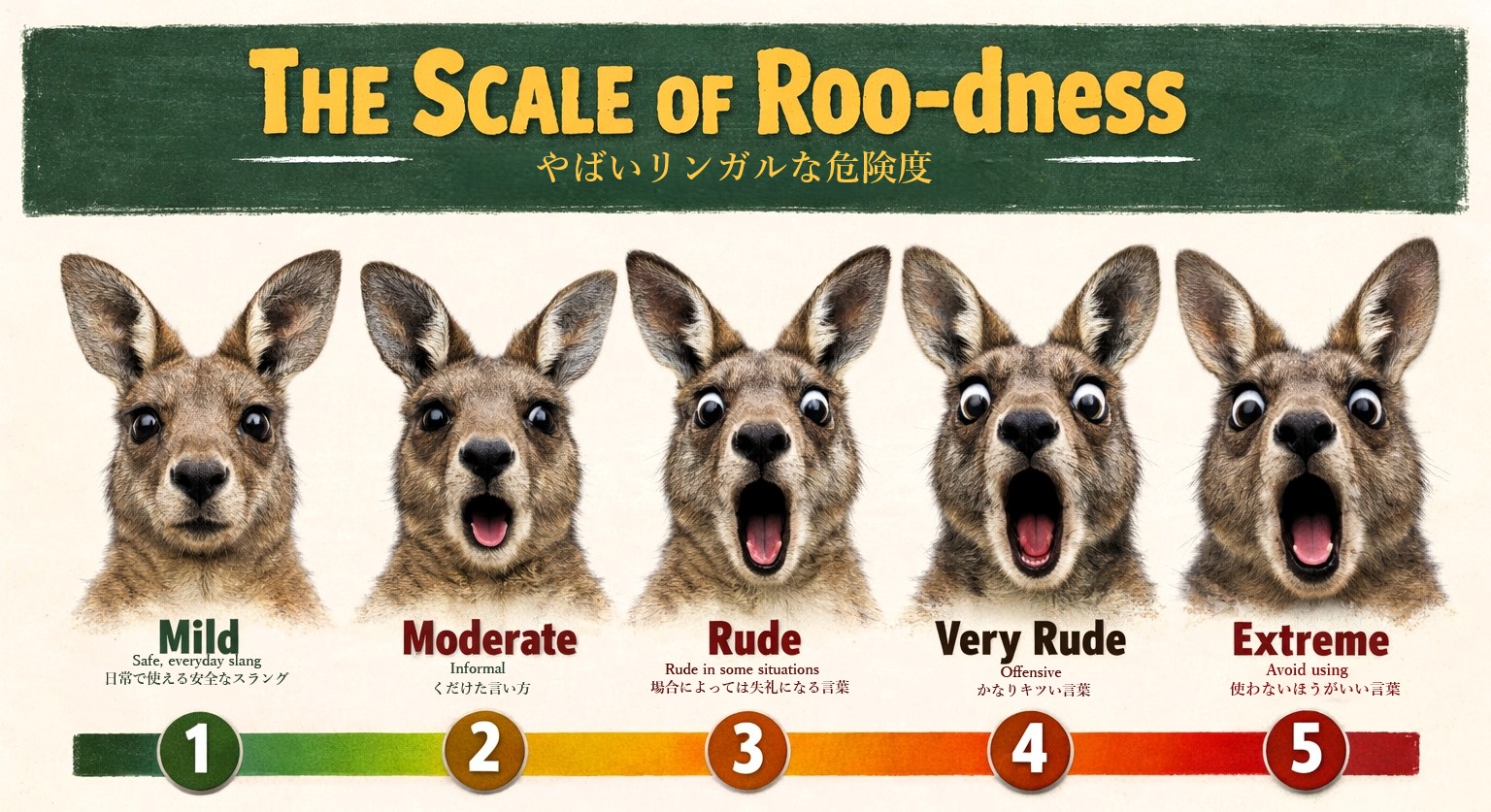

日本語とストラインに見られる、ちょっと「きわどい、、、(かも)」一面を日英併記でのぞいてみよう

Understanding The Scale Of Roo-dness

The Scale of Roo-dness is a Kangaeroo system for measuring how rude or strong a Yabailingual expression is. Yabailingual is a Japanese-English portmanteau of yabai, which has many meanings in Japanese but in this case it’s probably “risky,” and the English, lingual.
Scale of Roo-dness はストライン(オージー英語)のやばいリンガル表現の強さや失礼度を測る仕組みです。

  • Dole Bludger(ドール・ブラジャー)ってHarry Potterと関係ある?

    オーストラリアで言われたくない言葉の一つ 失業している人すべてが dole bludger ではありません。 この言葉は、働けるのに働こうとせず、失業給付だけを受け続けている人 を皮肉る表現です。 Bludger には、「人に頼って楽をする人」「怠け者」という意味があります。BludgerはHarry Potter世界のスポーツであるQuidditchに使うボールの一種であるが、ストラインのbludgerと全く関係ない。 そのため dole bludger はかなり失礼な言い方になります。 政治や選挙の時期になると、メディアやSNSで見かけることもありますが、面と向かって使えば相手を強く侮辱する表現になるので注意しましょう。 意味 働こうとせず、失業給付だけに頼って生活している人。 The Scale Of Roo-dness 🦘🦘🦘🦘☆ かなり失礼な表現です。 例文 He’s just a dole bludger. 「彼は働こうとしないで給付金に頼っているだけだ。」 日本語では? 「税金で暮らしている怠け者」 というニュアンスですが、かなり侮辱的です。 Rooの気づき スラングには、その時代の社会や政治が映し出されます。 だからこそ、意味だけでなく、どんな場面で使われるのかを知ることも大切です。

  • なぜDog’s Balls(ドッグズ・ボールズ)はBarking Madにさせる?

    オーストラリア人はなぜこんな表現を使うの? 最初にお断りしておきます。 品のいい表現ではありません。 でも、オーストラリアでは意外によく耳にします。 Dog’s balls は、 「ものすごく分かりやすい」「誰が見ても明らか」 という意味の俗語です。 由来は……そのままです。 犬を見れば、雄か雌かは一目瞭然。 そこから、 “It’s as obvious as dog’s balls.” という表現が生まれました。 意味は、 「そんなの見れば分かるでしょ。」 というニュアンスです。 要注意:激似イギリス英語のDog’s bollocksと勘違いしないでくださいね。Dog’s bollocksの由来が全く同じですが、それが「最高!」「これ以上良いものない」ような意味であり、ストラインのdog’s ballsとかなり意味合いがずれています。 意味 非常に明白であること。 The Scale Of Roo-dness 🦘🦘🦘☆☆ 少し下品ですが、強い悪口ではありません。 フォーマルな場では避けましょう。 例文 It’s as obvious as dog’s balls. 「そんなの見れば分かるよ。」 日本語では? 「火を見るより明らか」 「見え見え」^@@ 「誰が見ても分かる」 オージー英語(ストライン)には、思わず笑ってしまう比喩がたくさんあります。少々品がなくても、ユーモアを忘れないところがオージーらしさなのかもしれません。

  • What Does “Dodgy” Mean?

    やばいリンガル: 「Dodgy」はどういう意味? オーストラリアで何かを見て、”That looks a bit dodgy.” と言われたら、あまり良い意味ではありません。 Dodgy は、「怪しい」「信用できない」「なんだか危なそう」という意味で使われる、とても便利なオージー英語です。 中古車が dodgy。 ネットショップが dodgy。 工事の出来が dodgy。 天気まで dodgy と言われることがあります。 つまり、「何かがおかしい」「安心できない」と感じたときに使える万能単語なのです。 One word. Hundreds of uses. A used car can be dodgy. A business deal can be dodgy. The weather can look dodgy. Even your stomach after questionable seafood can feel dodgy. That’s why Australians love the word. At its heart, dodgy means something isn’t quite right. Maybe it’s dishonest. Maybe it’s unreliable. Maybe it just feels suspicious. Unlike stronger insults, dodgy is often playful. Australians use it every day to describe almost anything that causes doubt. 意味 怪しい、信用できない、いい加減な 危険度 🟢 ★☆☆☆☆ 日常会話で普通に使われる表現です。 例文 That website looks a bit dodgy. 「そのサイト、ちょっと怪しいね。」…

  • やばいリンガル:Chew And Spew

    Chew and Spew is Strine for a cheap burger shop. It is humorous and slightly rude slang. 日本語の意味 Chew and Spew は安いハンバーガー店のストライン俗語です。直訳すると「噛んで、ゲボ」となる。 Explanation Chew and spew describes fast food eaten quickly. The term is intentionally crude and funny. 日本語での解説 安いバーガー店を冗談で呼ぶ表現です。少し下品なユーモアです。 Example “Let’s grab a bite at the chew and spew.”「チープとうまくないバーガー屋に行こう。」 Strine Culcha Strine humor often uses rhyming and exaggeration. オージー文化メモ ストラインは韻や誇張で笑いを作ります。 Related Terms

  • Derro Is Merely The Start Of Derogatory

    Derro is Strine (Australian English) for a derelict or homeless person. Dero can also describe a run-down urban area. ストライン日本語の意味Derro はホームレスや荒れた地域を指すストラインです。 ExplanationDerro is informal and sometimes considered rude. It reflects rough urban slang in Australia. 日本語での解説やや失礼な言い方で、スラングです。 都市の荒廃を表すこともあります。 Example“That old building is full of derros.”「あの古い建物にはホームレスがいる。」 Strine CulchaStrine slang can be blunt and socially reflective. オージー文化メモストラインは社会の現実を直接表現します。 Related Terms

  • やばいリンガル:Too Good For You, Ya Mongrel

    お前にはもったいないよ、この野郎! “Too good for you, ya mongrel” is a humorous Strine expression used when someone else receives something desirable that you jokingly think you deserve more. 日本語の意味 友人が何か良いものを手に入れたときに、「それは本当は自分の方がふさわしいのに!」という気持ちを冗談っぽく表現するオーストラリア英語(ストライン)です。 Explanation Australians often show affection through teasing. “Too good for you, you mongrel!” is usually said with a smile rather than genuine annoyance. The expression became famous through Australian comedian and actor Paul Hogan, who frequently used it in his television appearances. 日本語での解説 オーストラリア人は親しい相手をからかうことで親しみを表現することがあります。 この表現は「ずるい!」「なんでお前なんだよ!」という気持ちをユーモラスに伝える言い回しです。 ここで使われる “mongrel” は本来「雑種犬」という意味ですが、この場合は本気の悪口ではなく、友人同士の軽い冗談です。 この表現は「クロコダイル・ダンディー」でお馴染みとなったポール・ホーガンさんが1970年代から始まったテレビのバライエティ番組にてよく使われて浸透した話でした。 Example “Steve won the raffle again.” “Too good for you, you mongrel!” 日本語訳 「スティーブがまた福引で当てたよ。」 「お前にはもったいないよ、この野郎!」 Strine Culcha Australian humour often relies on playful insults. Expressions that sound rude to foreigners are frequently signs…

  • やばいリンガル:Funnel Web Spider

    オーストラリアは猛毒生物の宝庫として知られているが、弁護士、政治家、鉱山王、フィッシュ&チップス屋の連中という強力なライバルを押しのけて、最凶の座をかろうじて勝ち取っているのが「ジョウゴグモ(funnel web spider)」だ。 そして驚くべきことに、このちっこいクモが主に生息しているのは、シドニー:昔から “Sin City(罪の街)” と呼ばれてきた街の周辺である。 Australia is known for its deadly fauna and despite fierce competition from lawyers, politicians, mining magnates, fish and chip shop operators, just scraping in as the most venomous of all of Australia’s creepy crawlies is the funnel web spider. Perhaps not surprisingly, this tiny spider is found mostly in and around Sydney, Australia’s self-professed Sin City. 体長はせいぜい5センチほどだが、毒は潜在的に致命的。ただし1981年に抗毒素が開発されて以来、ファンネルウェブスパイダーの咬傷で亡くなった人は一人もいない。 Though it only grows to a maximum of 5 cm, its venom is potentially fatal, though no funnel web spider bite has killed anyone since 1981, when an anti-venom was developed.

  • やばいリンガル:Shithouse

    ストラインでは「shithouse」が質が悪いや結果が芳しくないと意味しています。直訳すると「糞の家」という意味になり、外便所に使われている「Outhouse」と「Dunny」と関連性がありながら微妙に意味が違う。 Shithouse is Strine for poor quality, or unenjoyable. It literally means “house of shit.” Though closely associated with outhouse and dunny, which are words to describe outside toilets, the meaning of shithouse is slightly more nuanced. Reference 豪キャブラリー:Brick shithouse | 考えRoo Outhouse – Wikipedia Dunny 外便所 – Wikipedia

  • やばいリンガル:Westie

    A westie, at least the version in Strine, is a bogan from the western suburbs of Sydney. A bogan, of course, is a person whose speech, mannerisms, appearance, clothing, behaviour, or attitudes are considered unrefined or unsophisticated. Bogans are often symbolized by a flannie and a mullet. 「Westy」とは、少なくともストライン(オーストラリア英語)における定義では、シドニー西部の郊外出身の「bogan」を指す。言うまでもなく、「bogan」とは、話し方、仕草、外見、服装、振る舞い、あるいは態度が、洗練されていない、あるいは野暮ったいと見なされる人のことだ。ボーガンは、しばしばフランネルシャツとマレットヘアで象徴される。 There are numerous types of bogans, including the snow bogans who swarm to Japan on bogan missiles. And New Zealand English, which is like an emerging version of Strine, also has westies, these being from the western suburbs of Auckland. The Japanese equivalent to the bogan or westie is the yankii. 「Bogan missile」に乗って来日に蔓延している「snow bogans」を含めて、ボーガンには様々なタイプが存在する。また、ストラインの派生版とも言えるニュージーランド英語にも「westy」という言葉があり、こちらはオークランドの西郊外出身者を指す。ボーガンやウェスティに相当する日本の言葉は「ヤンキー」である。

  • やばいリンガル:Cheeky

    Cheeky has a few meanings in Strine, as outlined in the table below. In itself, cheeky is not a rude word, implying a tad of naughtiness. ストライン(オージー英語)には「Cheeky」が以下の通りのいくつかな意味がある。Cheeky事態が悪口言葉ではない。ちょい悪って感じ。 ストラインの意味 日本語の意味 Disrespectful, rude, impolite 失礼な、無礼な、行儀の悪い Mischievous, disobedient, unruly いたずら好き、言うことを聞かない、手に負えない