Reminiscing: The First Time Australia Mattered in Kangaeroo’s Japan
Kangaeroo has lived in Japan since the late ’80s, just as the Showa Era (reign of Emperor Hirohito from 1926-1989) drew to a close.
Japan back then had possibly an even stronger fascination with English than it does even today, especially as it was far less accessible in a slower, less connected world.
But English and overseas meant America and Japan had an obsession for the United States. Occasionally, news would filter through from other powers, such as then recently reunited Germany, France, Italy, Britain and the crumbling Soviet Union and Russia.
It was rare, pretty close to unheard of, really, for Australia to attract much attention in a Japan then apparently poised to overcome the U.S. as the world’s leading economy.
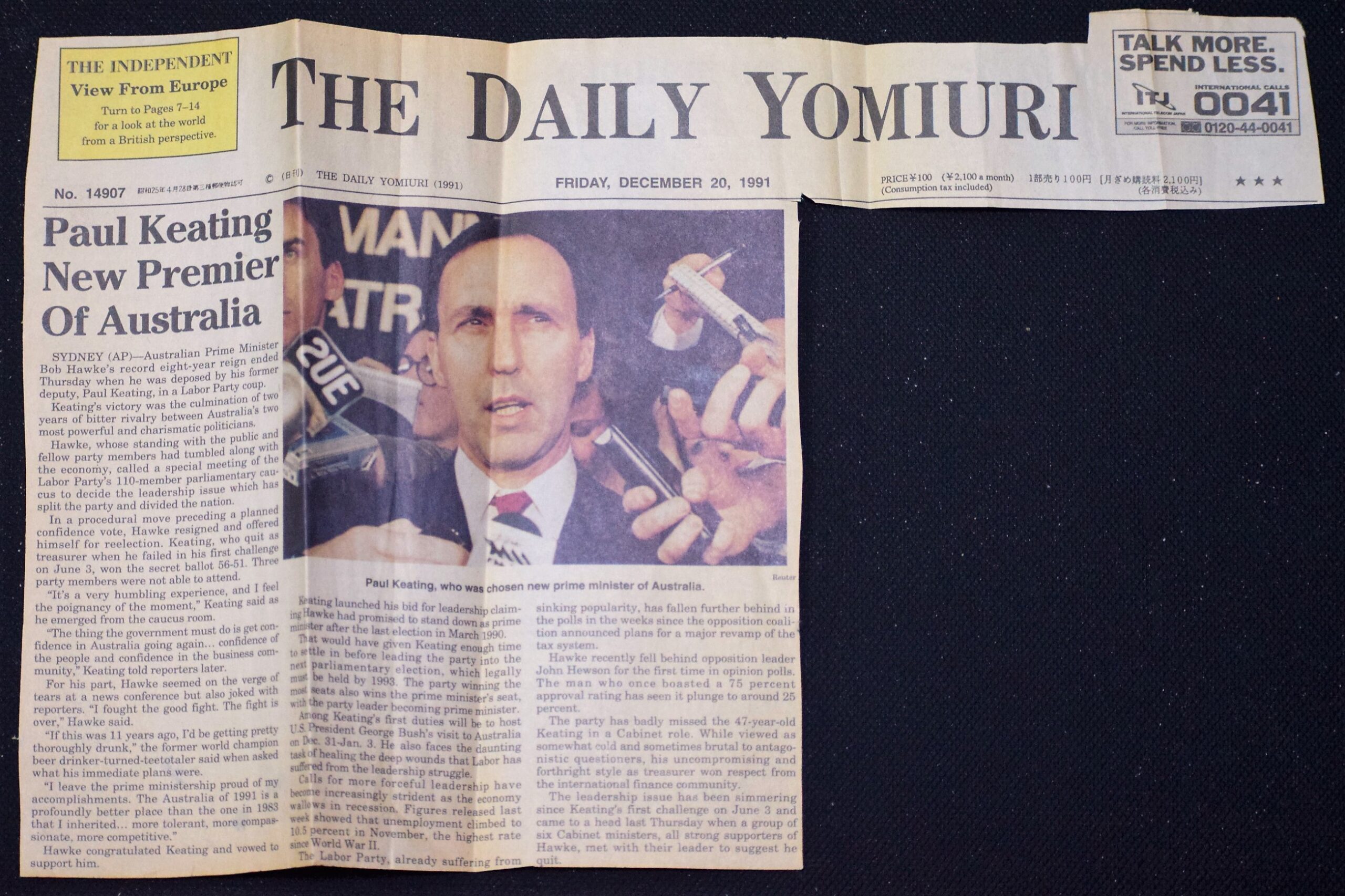
So unheard of, actually, that when Oz did make news, it was enough for Kangaeroo to grab a copy of the English paper from a kiosk at Shibuya Station. And keep it for more than 30 years!
Paul Keating had just successfully challenged Bob Hawke as prime minister and took over leadership of a country in a deep recession. Here’s how the Daily Yomiuri reported the matter in its lead story for the December 20, 1991 edition.
Paul Keating New Premier Of Australia
SYDNEY (AP) – Australian Prime Minister Bow Hawke’s record eight-year reign ended Thursday when he was deposed by his former deputy, Paul Keating, in a Labor Party coup.
Keating’s victory was the culmination of two years of bitter rivalry between Australia’s two most powerful and charismatic politicians.
Hawke, whose standing with the public and fellow party members had tumbled along with the economy, called a special meeting of the Labor Party’s 110-member parliamentary caucus to decide the leadership issue which has split the party and divided the nation.
In a procedural move preceding a planned confidence vote, Hawke resigned and offered himself for reelection. Keating, who quit as treasurer when he failed in his first challenge on June 3, won the secret ballot 56-51. Three party members were not able to attend.
“It’s a very humbling experience, and I feel the poignancy of the moment,” Keating said as he emerged from the caucus room.
“The thing the government must do is get coinfidence in Australia going again…confidence of the people and confidence in the business community,” Keating told reporters later.
For his part, Hawke seemed on the verge of tears at a news conference but also joked with reporters. “I fought the good fight. The fight is over,” Hawke said.
“If this was 11 years ago, I’d be getting pretty thoroughly drunk,” the former world champion beer drinker-turned-teetotaler said when asked what his immediate plans were.
“I leave the prime ministership proud of my accomplishments. The Australia of 1991 is a profoundly better place than the one in 1983 that I inherited…more tolerant, more compassionate, more competitive.”
Hawke congratulated Keating and vowed to support him.
Keating launched his bid for leadership claiming Hawke had promised to stand down as prime minister after the election in March 1990.
That would have given Keating enough time to settle in before leading the party into the next parliamentary election, which legally must be held by 1993. The party winning the most seats also win’s the prime minister’s seat, with the party leader becoming the prime minister.
Among Keating’s first duties will be to host U.S. President George Bush’s visit to Australia on Dec. 31-Jan. 3. He also faces the daunting task of healing the deep wounds that Labor has suffered from the leadership struggle.
Calls for more forceful leadership have become increasingly strident as the economy wallows in recession. Figures released last week showed that unemployment climbed to 10.5 percent in November, the highest since World War II.
The Labor Party, already suffering from sinking popularity, has fallen further behind in the polls in the weeks since the opposition coalition announced plans for a major revamp of the tax system.
Hawke recently fell behind opposition leader John Hewson for the first time in opinion polls. The man who once boasted a 75 percent approval rate has seen it plunge to around 25 percent.
The party has badly missed the 47-year-old Keating in a Cabinet role. While viewed as somewhat cold and sometimes brutal to antagonistic questioners, his uncompromising and forthright style as treasurer won respect from the international finance community.
The leadership issue has been simmering since Keating’s first challenge on June 3 and came to a head last Thursday when a group of six Cabinet ministers, all strong supporters of Hawke, met with their leader to suggest he quit.

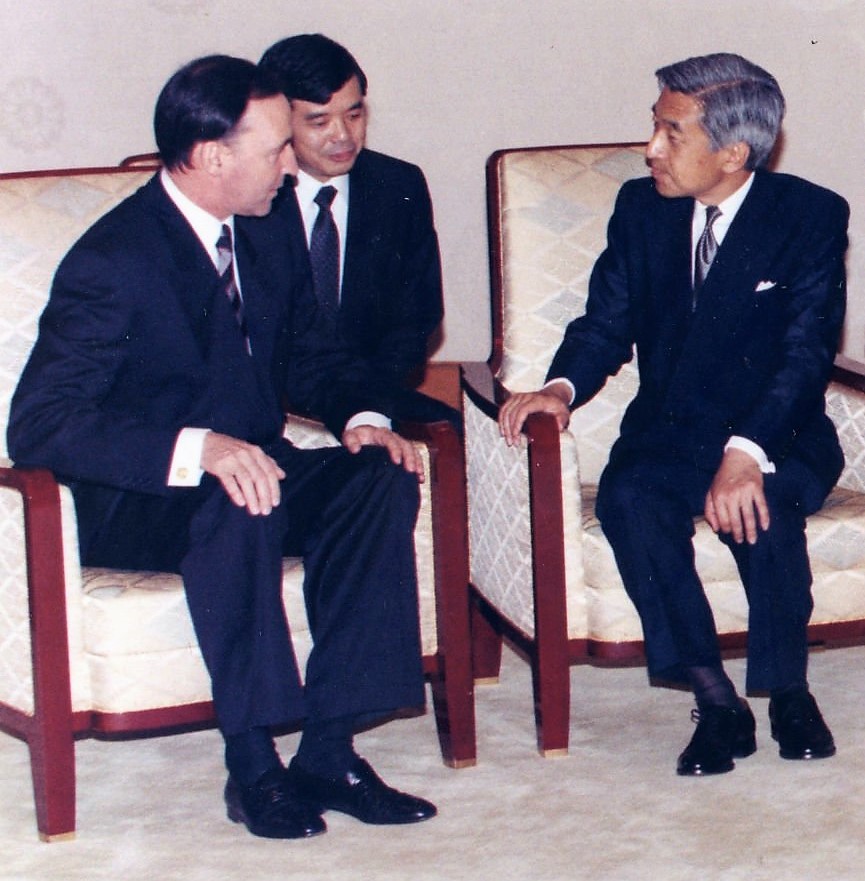
Keating would go on to lead Australia for the next five years, including an election win that was totally unexpected and increased Labor’s majority in 1993. He became a strong advocate of Australia fostering closer relations with Asian nations, including Japan, and remains so to this day. Keating lost the prime ministership to John Howard in 1996 and Australia would lurch strongly to the right and cling ever closer to the Anglosphere in a trend that remains pretty much unabated to this day. Keating’s pro-Asian stance would also usher in the racist Pauline Hanson, a polarizing figure and apparent far-right extremist when she emerged on the scene as a member of the Liberal Party in the mid-1990s, her views as leader of her own party, One Nation, are now regarded as almost mainstream. Indeed, Mark Latham, a former Labor Party leader once strongly likened to Keating, has become her closest and most outspoken political ally. Howard was strongly criticized as prime minister when he refused to condemn Hanson’s racism.
Hawke and Keating would patch up their differences and resume their strong friendship, which held until Hawke died in 2019. The recession that ended Hawke’s leadership and led to the Keating era was over the quarter the news reported above. Australia’s economic growth would continue uninterrupted for over 110 quarters until the pandemic hit.
Japan and Australia have since 1991 built an extremely strong relationship that it becoming even closer as the two countries deal with the looming threat of China.
Nonetheless, news of Australia remains a rarity in Japan, largely relating the annual bushfire season and occasionally a prime ministerial or sporting visit. But Australia is an undisputedly more significant presence in the Japan of 2022 than it had been in 1991.