Campbelltown Forest of Wild Birds A Slice of Oz in Sleepy Saitama

Koshigaya, located some 30 kilometers from downtown Tokyo, and Campbelltown, which is situated about 50 kilometers from Sydney’s central business district, were almost made for each other, even if only serving as satellite cities for their respective countries’ largest cities.
Koshigaya and Campbelltown are sister cities and it’s hard to see a better example of the custom than the relationship between the Japanese bed town and its Aussie sibling.
Koshigaya is also home to a picturesque corner of Australia, complete with wallabies, emus and some lovely wild birds, including rainbow lorikeets, superb parrots, Major Mitchell’s cockatoos, tawny frogmouths and kookaburras.
The Campbelltown Forest of Wild Birds in Koshigaya could arguably be one of the Kanto Plains areas best-kept secrets.
Though only a small-scale park, the attraction is overall an excellent one as it gives a reasonably close view of some delightfully colorful (mostly) Australian birds in a fairly authentic aviary, the largest of its type in Japan.
Surrounding the aviary are plenty of gum trees, adding to the Down Under-flavor of the Saitama Prefecture city.
Koshigaya and Saitama became sister cities in 1984, one of the earliest formal relationships between local governments in Australia and Japan.
The Campbelltown Forest of Wild Birds opened in 1995 to commemorate the 10th anniversary of the sister-city relationship.
Campbelltown reciprocates with its Koshigaya Park, containing Japanese gardens.
Details of the Campbelltown Forest of Wild Birds in Koshigaya are as follows:
Campbelltown Forest of Wild Birds(Japanese link)
272-1 Daikichi, Koshigaya, Saitama Prefecture, 343-0008
Open: 9 a.m. to 4 p.m. Closed Mondays, new year season holidays
Entrance fees: Adults 100 yen, children (primary and middle-school students) 30 yen
Related information on Koshigaya-Campbelltown ties
Campbelltown-Koshigaya Sister Cities Association
Campbelltown City Council page on sister city relations
Campbelltown-Koshigaya Sister Cities Association student delegates arrive to celebrate the 30th anniversary of their relationship
Campbelltown-Koshigaya friendship is 30 years young


Cop A Gander At These Rippers Too...

  • | |

    豪キャブラリー: Slab

    日本語でも「スラブ」という言葉をよく使うだが、コンクリートなどの四角い塊しか思い浮かばないだろう。英語でも全く同じ意味でslabも使うがslabも同様な形が由来の独特なオージー英語のslabもある。それがビールのslabなのだ。一ケースを示し、写真を見ればだいたい納得するだろう。

  • Dead Heart: Australia’s Desert Centre

    Australia has a heart. It is also, rather oddly, called dead. “The Dead Heart” is an old expression for the arid interior of Australia. The phrase became particularly influential after geologist John Walter Gregory used it as the title of his 1906 book The Dead Heart of Australia, following his expedition around Lake Eyre. The name reflects an older way of imagining Australia’s inland deserts as dry, empty and lifeless. Modern knowledge tells a much richer story: central Australia supports a remarkable range of plants, animals and human cultures. Even so, “the Dead Heart” remains part of Australian English and Australia’s historical vocabulary. Meaning 「Dead Heart」は、オーストラリア中央部の乾燥した内陸地域、特に砂漠地帯を指す古くからの表現です。この表現を広めた重要な人物が地質学者John Walter Gregoryで、1906年にThe Dead Heart…

  • | |

    Monkeying Around With Shared Kobe Steel(e)s

    Of the many commonalities shared by Australia and Japan, perhaps one of the quirkier ones is that both countries are home to a Kobe Steele known for monkeying around. Australia’s Kobe Steele founded the Orangutan Foundation International Australia (OFI Australia), and was awarded the Medal of the Order of Australia in 2021 for her services to conservation and the environment. Japan’s Kobe Steel Ltd., meanwhile, monkeyed around in a far less noble way, falsifying inspection and quality data on steel, aluminium and copper products for years, affecting hundreds of customers and resulting in billions of yen in fines after causing one of Japan’s most significant industrial quality scandals in recent…

  • | | |

    日本人コンビーが日豪融合ミュージックで豪を盛り上げる

     日本人男性がギターでブルーズを弾き、日本時女性が津軽三味線を弾く。合わせて、オーストラリアでストリート・パフォーマーそして大活躍するGeorge Kamikawa氏とNoriko Tadano氏が豪テレビの最も人気ある番組の一つ「Australia’s Got Talent」では、豪全国を30日で盛り上げた。  日本人コンビがそのブルーズと日本の伝統音楽の融合で同番組の準決勝まで進み、高い評価された。  Kamikawa氏は、約10年ぐらい前に活用する舞台を日本からニュージーランド経由でオーストラリアのメルボルン市に移った。そこで、Tadano氏と出会い、日本人同士で徐々に人気を集まった。  人気とともに通に評価されているという好条件を基にこれからオーストラリアで大ブレークが期待され、そこからさらにビッグなスターになればいいな。 「Australia’s Got Talent」での演奏 豪ABCテレビでの演奏

  • | | |

    How Did A 19th Century Kangaroo Spark Japan-Australia Ties That Now Seem A Perfect Match?

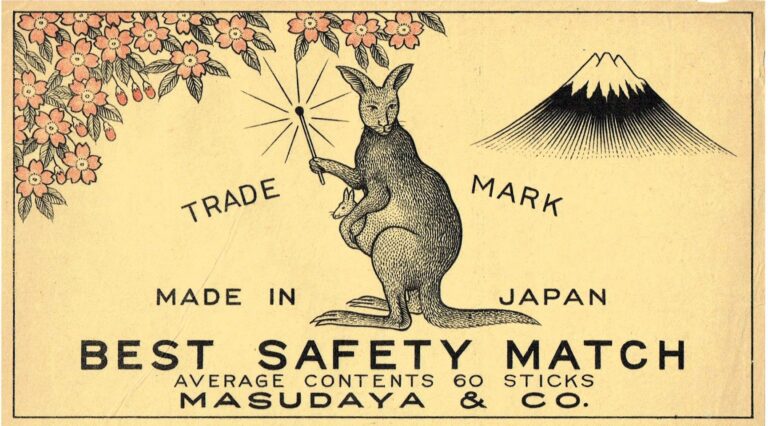
    カンガルーが火をつけた日豪交流 ― まさに“マッチ”した関係の始まり? Long before Australia became one of Japan’s closest partners, Japanese manufacturers had been using kangaroos to promote their products. The earliest documented reference to the commercial use of a kangaroo in Japan came from 1884, when a misemono traveling curiosity show advertised that it would feature a fukuro nezumi, literally a pouch mouse, at the Tenmangu Shrine grounds in Osaka. オーストラリアが日本の最も親しいパートナーの一つとなるはるか以前、日本のメーカーはすでにカンガルーを商品の宣伝に活用していました。 現在確認されている日本におけるカンガルーの最初期の商業利用は、1884年に大阪・天満宮境内で開かれた見世物興行の広告です。そこには、カンガルーが「袋鼠(ふくろねずみ)」として紹介されていました。 A Kangaroo on a Matchbox マッチラベルに描かれたカンガルー Japan first enacted a trademark registration system in June 1885, and Kobe-based match manufacturer Seisuisha registered its first trademark on Oct. 11 of that year. It was a matchbox featuring a lion. The lion was part of a series…