Goodbye Possums…
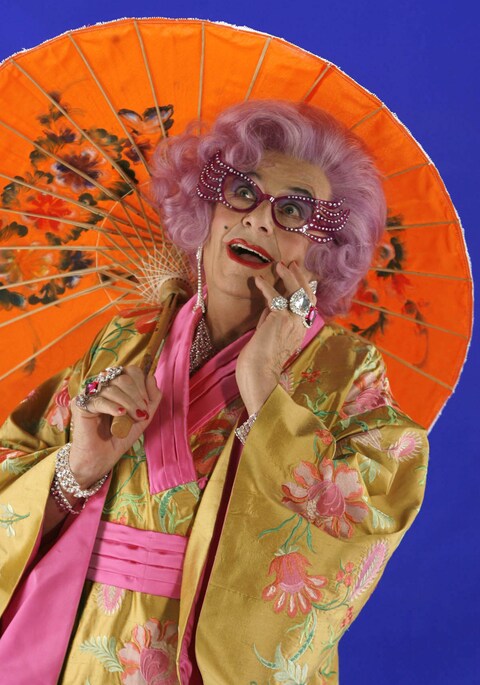
Barry Humphries, the creator of characters such as Dame Edna Everage – the Moonee Ponds housewife famous for her flamboyance and shouted greeting of “Hello Possums” – Sir Les Patterson and Sandy Stone, and himself an entertainer and icon of Straya in many parts of the world, has passed away.
Humphries died aged 89 on Saturday following complications from a recent hip surgery.
Personally, I wasn’t a great fan of the Moonee Ponds housewife — Dame Edna Average is my name for her — but she had her moments and was a wonderful example of Humphries’ acerbic, anti-Establishment wit that Australian author Kathy Lette described this morning as his brilliance at “pricking pomposity.”
For me, Humphries’ Sir Les Patterson was a much funnier figure than Dame Edna with his vulgar Ockerism, food-stained unfashionable suits, dalliances with lovely young secretaries and crude, booze-swilling antics a much more biting depiction of life Down Under than the gladiola-waving housewife. At least that was how I saw it, and my judgements of the characters as I knew them until I left Australia in the late ’80s.
Humphries was born into a wealthy family and had a privileged upbringing, but spent his career making a mockery of the Establishment. I shared his progressive political views and he, like me, was a recovering alcoholic, which helped me identify with him. I guess we didn’t see much of his alcoholic nature, but his four marriages and complicated family relations seem to attest to the typical struggles addicts have in getting along with others.

Poor Humphries was vilified by gender fanatics in his later years, who campaigned to have the Melbourne Comedy Festival’s Barry Awards renamed because of Humphries’ dismissal and smeared his name. He did not deserve that and I hope his legacy will be view fondly rather than being put in a falsely negative light.
Humphries and his characters didn’t really have much to do with Japan, with much of his humor tough to translate. He is possibly best known here for his stint playing Dame Edna in the dying days of the hit ’90s TV show, Ally McBeal.
I was surprised to see his fame was good enough to get him a Japanese language obituary on Yahoo News Japan this morning, Japan’s most-widely read mainstream news source.
Humphries gave an account of his mother’s love for Japan in the poignant essay, Mummy, I Hardly Knew You. Here is what he had to say:
In the winter of 1958, my parents and my Auntie Elsie embarked on a world cruise. The highlight of this for my mother was Japan, the last place I expected her to enjoy. Its standards of cleanliness must have met with her approbation. They went only to grand hotels and my mother must have enjoyed the women’s exotic attire.
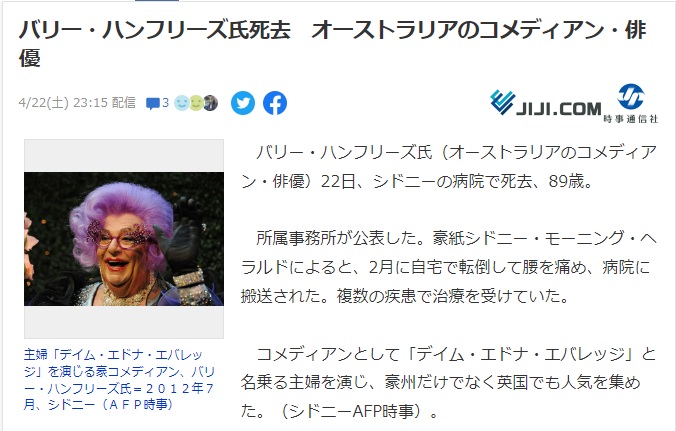
Dame Edna certainly made a trait of exotic attire. I’m not sure of contemporary Oz, but for the Australia that I knew, Humphries, or at least his characters, were an iconic part of the country and even if feelings about him were not particularly strong, they invariably existed for everyone, much in the same way that Jesus has an ubiquitous place in the thoughts of Americans.
I will miss Humphries’ in-your-face humor, and his subtle wit even more. And I will lament even further the demise of the era in which he thrived. But I thank him for what he gave. And for what he didn’t.